Epithelial QKI Protects Against Emphysema by Maintaining Mitochondrial Integrity

Epithelial QKI Protects Against Emphysema by Maintaining Mitochondrial Integrity
Uemasu, K.; Tanimura, K.; Miyamoto, A.; Hasegawa, K.; Lane, Z.; Nyunoya, R.; Uemasu, H.; Kaufman, B. A.; Kliment, C.; Chandra, D.; Sciurba, F. C.; Dela Cruz, C.; Sundd, P.; Alder, J.; Hu, J.; Nyunoya, T.
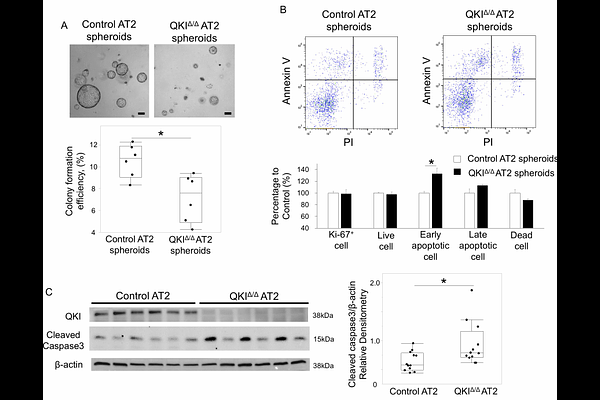
AbstractSingle-cell transcriptomic profiling of chronic obstructive pulmonary disease (COPD) lungs identified QKI, an RNA-binding protein, as a candidate emphysema-associated gene, but its epithelial role in COPD pathobiology remains unclear. We show that QKI expression is reduced in human COPD lungs and that alveolar type 2 epithelial (AT2) cell QKI protein levels correlate strongly with spirometric indices and diffusing capacity (DLCO). Lung epithelium-specific QKI knockout mice (QKI{Delta}/{Delta}) developed spontaneous airspace enlargement with emphysema-like mechanics, and QKI-deficient AT2 cells showed impaired spheroid colony formation and increased apoptosis. Integrated transcriptomic and proteomic analyses of primary AT2 cells revealed a selective reduction in functional mitochondrial (respiratory-chain and metabolic) protein abundance despite relatively preserved transcript levels, consistent with mitochondrial transcriptome-proteome discordance. QKI loss increased mtDNA abundance and TOMM20 staining but decreased ATP5A, indicating accumulation of structurally increased but functionally dysfunctional mitochondria. In human epithelial cells, CRISPR-mediated QKI deficiency reduced oxidative respiration, increased glycolytic reliance, elevated mitochondrial ROS and membrane potential, and increased apoptosis; these phenotypes were partially rescued by QKI re-expression. These findings identify epithelial QKI as a regulator of mitochondrial integrity and stress tolerance in COPD.