Nutrishield Beta-Carotene Attenuates LPS-Induced Systemic Inflammation and Oxidative Stress in Murine Model

Nutrishield Beta-Carotene Attenuates LPS-Induced Systemic Inflammation and Oxidative Stress in Murine Model
Fu, J.; Yu, S.; Ngoa, K.; Teo, X. H.; Ovais, M.
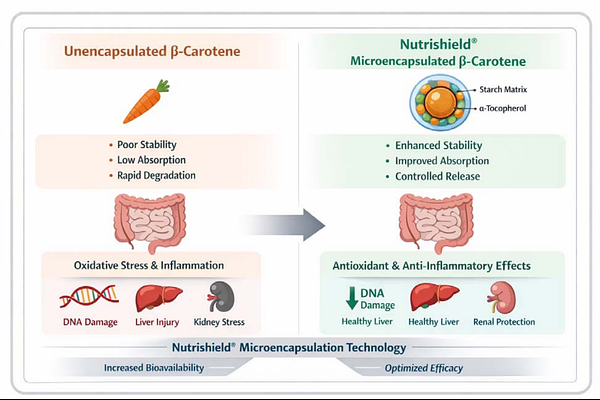
AbstractBeta-carotene is a strong antioxidant and immunomodulator, but it breaks down in the presence of oxygen and isn't readily bioavailable. Nutrishield beta-carotene is a special starch-based microencapsulation system designed to protect beta-carotene from oxidation, make it easier to spread in the gastrointestinal environment, and improve its effectiveness. This study reported Nutrishield as a formulation platform by using beta-carotene as a model compound. We compared how well it worked in vitro and in vivo with beta-carotene that wasn't encapsulated. We randomly put thirty-two male BALB/c mice into four groups (n=8): Control, LPS, LPS + beta-carotene (10 mg/kg/day), and LPS + Nutrishield (the same dose of beta-carotene). After an intraperitoneal injection of LPS (1 mg/kg, twice weekly), the treatments were administered orally for 28 days. LPS administration significantly elevated TNF alpha (142 pg/mL), IL-6 (118 pg/mL), and serum 8-OHdG (5.4 ng/mL) in comparison to controls (TNF alpha = 62 pg/mL; IL-6 = 51 pg/mL; 8-OHdG = 2.1 ng/mL). Nutrishield beta-carotene supplementation significantly normalized cytokine profiles (TNF alpha 69 pg/mL; IL-6 = 56 pg/mL; IL-10 increased from 38 to 76 pg/mL; p < 0.001 vs. LPS). Histological analysis demonstrated reduced hepatocellular vacuolation and renal tubular degeneration in the Nutrishield beta-carotene group relative to the beta-carotene and LPS groups. These findings demonstrate that Nutrishield microencapsulation significantly enhances the functional antioxidant and anti-inflammatory efficacy of beta-carotene in a murine model of systemic inflammation.