An Exponential Sample-Complexity Advantage for Coherent Quantum Inference

An Exponential Sample-Complexity Advantage for Coherent Quantum Inference
Zhaoyi Li, Elias Theil, Aram W. Harrow, Isaac Chuang
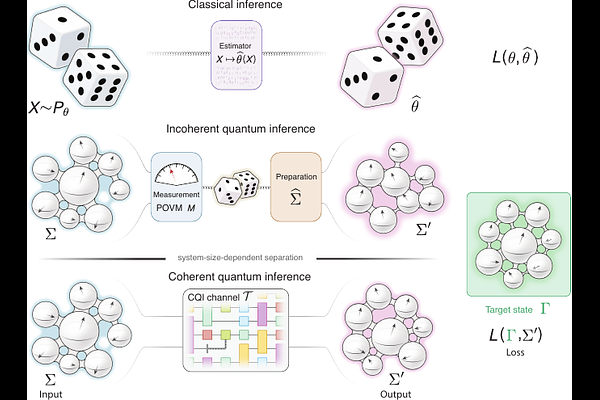
AbstractStandard quantum inference converts quantum data into classical outputs. We study an alternative inference setting in which the desired output is quantum, preserving coherence. Such settings include quantum purity amplification (QPA), mixed-state approximate purification or cloning, and density matrix exponentiation. We show that such protocols can achieve exponentially lower sample complexity than incoherent, measurement-mediated protocols. For QPA with principal eigenstate targets and $d$-dimensional inputs, coherent processing achieves error $\varepsilon$ using $O(1/\varepsilon)$ copies, versus the $Ω(d/\varepsilon)$ copies required by any incoherent protocol. Together, these sharp coherent-incoherent separations seed a theory of coherent quantum inference, with an entanglement-breaking limit identifying the optimal incoherent counterpart of each coherent protocol.