Sequence-level vocal convergence in common marmosets

Sequence-level vocal convergence in common marmosets
Wewhare, N.; Burkart, J. M.; Wierucka, K.
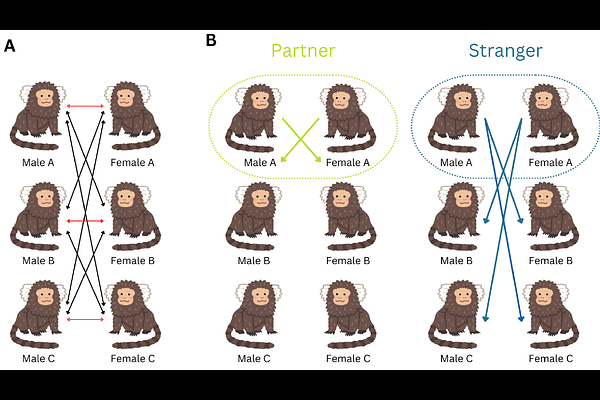
AbstractVocal accommodation is the process by which individuals adjust their vocalizations to resemble those of social partners. This phenomenon is widespread in social animals and can reinforce affiliation, signal group identity, and facilitate coordination. Most studies of vocal accommodation have focused on convergence in the acoustic structure of individual calls. Whether social partners also converge in how calls are arranged into sequences remains largely unknown. We examined vocal convergence during pair formation in common marmosets (Callithrix jacchus) by recording phee sequences from nine dyads composed of three males and three females before pairing and again four months after, in two audience contexts: when individuals interacted vocally with their partner or with an opposite sex stranger. We quantified similarity between individuals in call sequence-structure using transition probabilities, bigram frequencies, repeat-length distributions, and local alignment, and quantified similarity in acoustic structure using spectral parameters, MFCCs, and dynamic time warping. We found vocal convergence on a sequence level. After pair formation, partners became more similar in sequence structure when calling to strangers, whereas no change was detected in partner directed sequences. In contrast, call acoustic structure did not change in either context. Because vocal repertoires are constrained by anatomy and physiology, reorganizing existing call types into different combinations may provide a flexible route for modifying signals without altering the acoustic structure of individual calls. Our results provide evidence that social bonds can drive sequence level vocal convergence in a non-human primate, suggesting that vocal flexibility may arise not only through changes in acoustic structures but also through changes in how calls are organized over time.