Cerebellar function remains resilient under increased task demands in healthy adults up to 80 years but it is task-specific and independent of cerebellar structure

Cerebellar function remains resilient under increased task demands in healthy adults up to 80 years but it is task-specific and independent of cerebellar structure
Matthijs, A.; de Witte, A.; Mantini, D.; Orban de Xivry, J.-J.
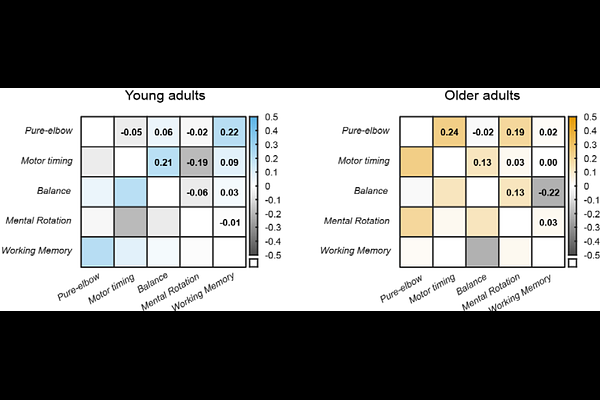
AbstractHealthy aging is associated with progressive structural brain decline, yet the loss of functional abilities varies across individuals, which has been linked to reserve mechanisms. Within the framework of complex systems theory, reserve is thought to manifest as resilience when the system is challenged by stressors, such as increases in task difficulty. The cerebellum has been proposed as a potential source of motor reserve, but empirical evidence linking cerebellar structure, function, and resilience remains limited. We conducted a cross-sectional study including 50 young, 80 older, and 30 older-old adults to examine resilience to increasing task demands across cerebellar-specific and general outcomes. Participants completed three motor tasks (pure elbow motion, motor timing, postural stability) and two cognitive tasks (mental rotation, spatial working memory). Structural MRI was acquired to quantify cerebellar grey matter volume within functionally defined regions. Cerebellar-specific motor measures (anticipatory muscle activation and timing variability) were preserved across age groups and remained resilient under increased task demands, including in adults over 80 years of age. In contrast, general sensorimotor performance (postural sway) declined with age and showed reduced resilience. Within the cognitive domain, both cerebellar-specific and general measures showed comparable age-related declines and reduced resilience. Resilience measures were not correlated across tasks, indicating that resilience is task- and domain-specific. Furthermore, cerebellar grey matter volume did not predict resilience in motor or cognitive outcomes. These findings support the cerebellar motor reserve hypothesis, suggesting that cerebellar-dependent motor processes remain resilient despite age-related structural decline. However, resilience appears to be function-specific rather than a generalized individual trait. Overall, the results highlight dissociations between brain structure, function, and resilience, underscoring the selective contribution of the cerebellum to motor preservation in healthy aging.