P95-HER2 promotes metastatic progression by biasing MRTFA dependent signaling

P95-HER2 promotes metastatic progression by biasing MRTFA dependent signaling
Fernandes, J. D.; Bresnahan, E.; Zawada, H.; Ginzel, J. D.; Lyerly, H. K.; Rogers, B.; Kavuri, S. M.; Introne, A. J.; Sadecki, M. R.; Mori, H.; Doherty, G.; Borowsky, A. D.; Flores, K. B.; Bravo-Cordero, J. J.; Snyder, J. C.
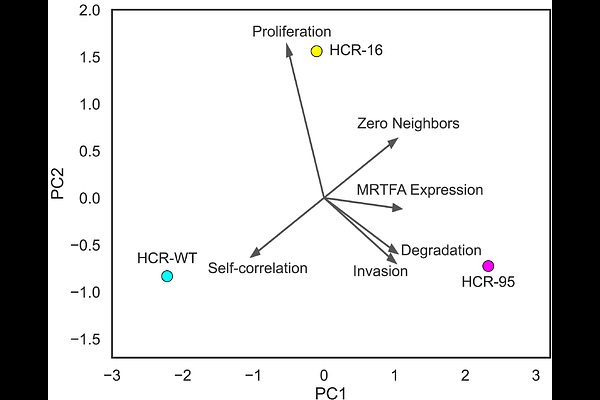
AbstractNaturally occurring isoforms of the proto-oncogene Erb-B2 Receptor Tyrosine Kinase 2 (ERBB2, HER2) incite unique pathways of tumor progression in mouse models of breast cancer. Although each isoform has been shown to progress to metastasis, the N-terminally truncated isoform (p95) was previously shown to be biased toward early distant dissemination prior to detection. Here we show how HER2 isoforms differentially promote go-or-grow phenotypes through biased utilization of tyrosine autophosphorylation sites in the intracellular tail of HER2. Fluorescently barcoded humanized full-length HER2 (WT), exon-16 splice HER2 isoform (d16), and p95 expressing tumor cell lines were derived from HER2 Crainbow mice, then utilized for a series of functional assays including proliferation, tumor growth rate, cell motility, collective cell migration, cellular morphology, and invasive potential. Quantitative analysis reveals biased tumor cell behaviors across each genotype. WT tumor cells are biased toward proliferation and collective migration, d16 cells are biased toward proliferation and individual motility, and p95 tumor cells are biased toward individual motility and invasion. Single cell analysis reveals a myogenic-like state transition in p95 cells accompanied by an increased nuclear translocation of the Myocardin Related Transcription Factor A (MRTFA). MRTFA knockdown, as well as knockdown of a downstream effector, Transforming growth factor beta 1 induced transcript 1 (TGFB1I1), both inhibit the p95 invasive phenotype. Furthermore, intracellular residue tyrosine 1139 (Y1139) is necessary for MRTFA translocation, and when edited in p95 cells (Y1139F) invasion and motility phenotypes are subsequently lost. Our data illustrate the importance of functionally selective signaling in HER2 and highlight the need for therapeutics that intercept metastasis by targeting HER2 biased signaling.