Multi-Mode Quantum Annealing for Variational Autoencoders with General Boltzmann Priors

Multi-Mode Quantum Annealing for Variational Autoencoders with General Boltzmann Priors
Gilhan Kim, Daniel K. Park
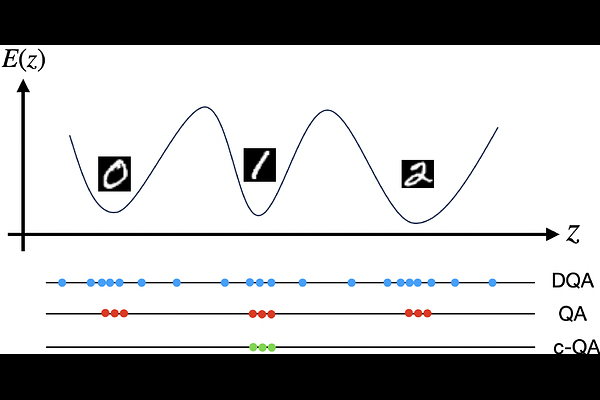
AbstractVariational autoencoders (VAEs) learn compact latent representations of complex data, but their generative capacity is fundamentally constrained by the choice of prior distribution over the latent space. Energy-based priors offer a principled way to move beyond factorized assumptions and capture structured interactions among latent variables, yet training such priors at scale requires accurate and efficient sampling from intractable distributions. Here we present Boltzmann-machine--prior VAEs (BM-VAEs) trained using quantum annealing--based sampling in three distinct operational modes within a single generative system. During training, diabatic quantum annealing (DQA) provides unbiased Boltzmann samples for gradient estimation of the energy-based prior; for unconditional generation, slower quantum annealing (QA) concentrates samples near low-energy minima; for conditional generation, bias fields are added to direct sampling toward attribute-specific regions of the energy landscape (c-QA). Using up to 2000 qubits on a D-Wave Advantage2 processor, we demonstrate stable and efficient training across multiple datasets, with faster convergence and lower reconstruction loss than a Gaussian-prior VAE. The learned Boltzmann prior enables unconditional generation by sampling directly from the energy-based latent distribution, a capability that plain autoencoders lack, and conditional generation through latent biasing that leverages the learned pairwise interactions.