Dual AAV amelioration of Lama2-null muscular dystrophy and neuropathy

Dual AAV amelioration of Lama2-null muscular dystrophy and neuropathy
McKee, K. K.; Yurchenco, P. D.
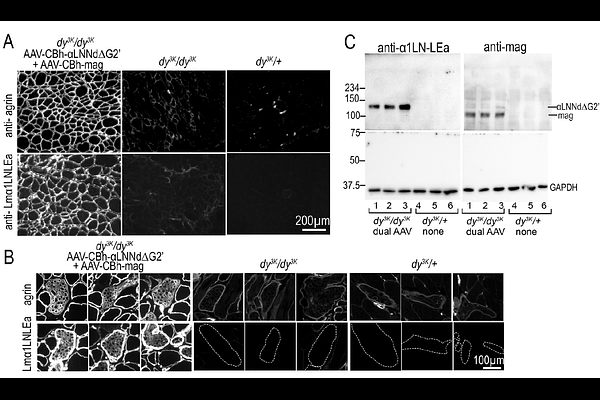
AbstractThe dy3K/dy3K Lama2-/- mouse is a model for the severe form of LAMA2-related dystrophy and peripheral neuropathy (LAMA2-RD). In the dystrophic mice, a compensating laminin subunit, Lm-a4, that lacks polymerization and a-dystroglycan-binding activity, replaces the missing Lm-a2 subunit. It was previously found that an a4-laminin can be modified with two small laminin-binding linker proteins, i.e. aLNNdDelG2 and miniagrin to facilitate polymerization and a-dystroglycan binding respectively, to enable the key missing functions. Adeno-associated virus serotype 9 (AAV9) was used to deliver minigenes coding for the two proteins in dystrophic mice. AAV9-aLNNdDelG2 utilized a universal CBh promoter while AAV9-miniagrin utilized either the CBh promoter or muscle-specific SPc-512 promoter. The phenotype in the dy3K/dy3K mice was evaluated following i.v. postnatal injection with either AAV9-aLNNdDelG2 alone or in combination with AAV9- aLNNdDelG2 + AAV9- miniagrin. Double AAV treatment was found to substantially increase survival and ambulation, as well as increase forelimb grip-strength and improve muscle histology. Of note, the sciatic nerve amyelination characteristic of laminin a2-deficiency was prevented. While single treatment with aLNNdDelG2 was inferior to double treatment for muscle strength and survival, it corrected the radial sorting deficit equally, revealing that enablement of laminin polymerization is a sufficient requirement for myelination.