cf-Cabernet: Nick Repair Prior to End Repair Preserves Endogenous DNA Methylation Information in Cell-Free DNA Methylation Sequencing

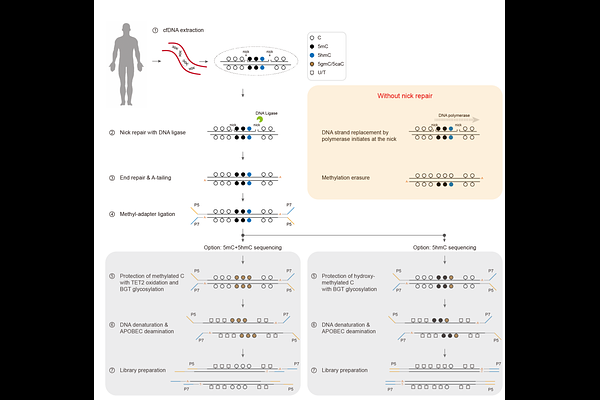
cf-Cabernet: Nick Repair Prior to End Repair Preserves Endogenous DNA Methylation Information in Cell-Free DNA Methylation Sequencing
Yuan, T.; Bai, Y.; Song, L.; Zhang, A.; Liu, Y.; Cao, Y.
AbstractCell-free DNA (cfDNA) methylation profiling holds great promise for non-invasive cancer detection, yet accurate methylome analysis is compromised by DNA damage inherent to cfDNA. Standard library preparation workflows involve an end-repair step during which DNA polymerases can initiate synthesis from single-strand breaks (nicks), replacing endogenous methylated nucleotides with unmethylated nucleotides in the 3' direction and systematically erasing methylation information. This artifact is distinct from the terminal jagged-end effect and disproportionately affects cfDNA and FFPE DNA, which harbor abundant nicks. Here, we developed cf-Cabernet, which builds upon the Cabernet framework (Cao et al., 2023) -- an enzymatic methylation sequencing method featuring carrier DNA-assisted sample recovery and amplification-friendly post-conversion processing -- with the addition of a Taq DNA ligase-mediated nick repair step prior to end repair. Using matched cfDNA samples, we compared cf-Cabernet against standard EM-seq and WGBS. cf-Cabernet and EM-seq both substantially outperformed WGBS in alignment rate. Critically, while standard EM-seq exhibited globally reduced methylation levels compared to WGBS, cf-Cabernet yielded methylation levels concordant with WGBS. M-bias analysis revealed that EM-seq libraries showed persistently depressed methylation across the entire read length, whereas cf-Cabernet methylation recovered to the WGBS baseline beyond the terminal ~40 bp jagged-end region. Nick-induced methylation erasure during end repair is a significant but previously underappreciated source of error in cfDNA methylation sequencing. cf-Cabernet effectively mitigates this artifact through pre-emptive nick ligation, enabling accurate methylome profiling from damaged DNA templates. This method is broadly applicable to cfDNA, FFPE DNA, and other clinical specimens where DNA integrity is compromised, providing a robust foundation for methylation-based liquid biopsy applications.