Trans-allelic Epigenetic Dominance Disrupts Hybrid Endosperm Development in Wild Tomatoes

Trans-allelic Epigenetic Dominance Disrupts Hybrid Endosperm Development in Wild Tomatoes
Florez-Rueda, A. M.; Roth, M.; Staedler, T.
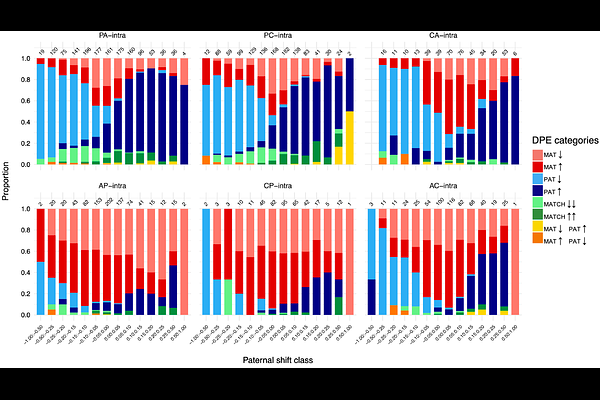
AbstractHybrid seed failure (HSF) is a major postzygotic barrier in wild tomatoes, yet the regulatory logic linking effective ploidy divergence to endosperm collapse remains unclear. We analyzed reciprocal interspecific crosses and quantified parent-of-origin expression genome-wide to test whether allelic imbalance in hybrid endosperm reflects dosage alone or lineage-specific trans regulation. Parental expression proportions were strongly asymmetric, with the most pronounced and repeatable shifts occurring in crosses involving Solanum peruvianum (Per). These shifts were often maintained across reciprocal contexts and included elevated maternal transcript proportions even in crosses classified as paternal-excess-like, arguing against a simple dosage-only model. We therefore classified differential parent-of-origin expression (DPE) genes into four Per-centered functional classes, revealing cross-consistent allelic responses and coordinated expression changes affecting large gene sets. Per-associated DPE was enriched for chromatin regulation, including DNA methylation/RdDM-related and chromatin remodeling factors and Polycomb-linked regulators, suggesting that impaired chromatin-based repression may contribute to allelic imbalance and developmental instability. In parallel, Per-associated activation of auxin and cell-cycle pathways in partner alleles points to disrupted hormone-dependent developmental transitions that govern proliferation and cellularization. Together, our results support a model of trans-allelic epigenetic dominance linking effective ploidy divergence to genome-wide expression polarization and HSF.