snpXplorer: an interactive platform for haplotype-aware exploration and integrated annotation of GWAS data

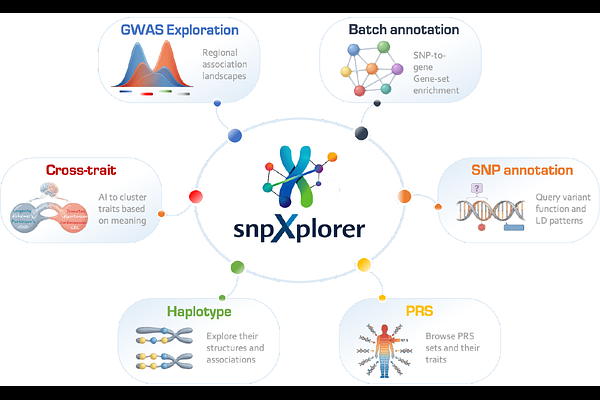
snpXplorer: an interactive platform for haplotype-aware exploration and integrated annotation of GWAS data
Tesi, N.; Green, G. S.; Salazar, A.; van der Lee, S. J.; Hulsman, M.; Holstege, H.; Reinders, M.
AbstractGenome-wide association studies (GWAS) have identified thousands of loci associated with complex traits and diseases, yet translating these signals into biological insight remains challenging. Most associated variants are non-coding and reside in linkage disequilibrium (LD) blocks, where multiple correlated variants jointly contribute to association signals. These clusters, or haplotypes, may capture shared regulatory and functional contexts. Interpreting GWAS signals thus requires approaches that integrate regulatory, functional, and cross-trait evidence, while preserving the broader haplotypic context of disease-associated loci. At the same time, the rapid growth of publicly available GWAS summary statistics has enabled large-scale cross-trait analyses, but also introduced redundancy across closely related phenotypes. Efficient interpretation of GWAS data therefore requires tools that integrate heterogeneous data sources while preserving genomic and biological contexts. We present snpXplorer, an interactive web platform for haplotype-aware exploration and annotation of GWAS data. The platform incorporates >10,000 GWAS datasets from OpenGWAS and enables multi-scale analysis across variants, haplotypes, genes, and traits. Key features include (i) a haplotype-based representation of association signals derived from LD structure, (ii) a unified variant annotation framework integrating clinical annotations (ClinVar), allele frequencies (gnomAD), functional predictions (CADD, AlphaGenome), quantitative trait loci (GTEx), structural variation, and GWAS associations, and (iii) cross-trait exploration using semantic similarity-based clustering of phenotypes. Use cases centered on Alzheimer's disease illustrate this utility: for example, at the TMEM106B locus, snpXplorer identified a haplotype linked to eleven distinct traits, revealing synergistic pleiotropy across neurological and behavioral phenotypes alongside antagonistic pleiotropy with height. snpXplorer allows users to browse, filter, and inspect variant-, haplotype-, gene- and trait-level evidence, lowering the barrier to biological interpretation of GWAS results. Compared with existing tools that focus on specific aspects of GWAS interpretation, the strength of snpXplorer is that it reduces the need for fragmented queries across databases.