From Variability to Synchrony: Non-linear Development of Auditory Neural Responses During the First Year of Life

From Variability to Synchrony: Non-linear Development of Auditory Neural Responses During the First Year of Life
Reisenberger, E.; Schabus, M.; Florea, C.; Angerer, M.; Reimann-Ayiköz, M.; Preiss, J.; Roehm, D.; Heib, D. P. J.; Fazelnia, C.; Ameen, M. S.
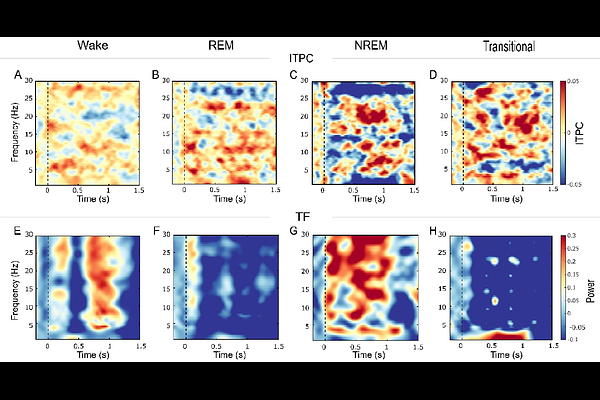
AbstractIn humans, the first year of life is characterized by rapid developmental changes, including substantial brain maturation. As a result, neural responses to auditory stimuli undergo marked changes during this period. In this study, we followed 69 infants across their first year of life and recorded high-density electroencephalography (hdEEG) at 2 weeks, 6 months, and 12 months postpartum. Infants were presented with pure beep tones to examine the development of neural responses to auditory stimulation. We analysed event-related potentials (ERPs), inter-trial phase coherence (ITPC), and time-frequency (TF) responses to the beep tones and controlled for arousal state during stimulus presentation. We found that with increasing age, neural responses became more pronounced and showed reduced trial-to-trial variability. Phase synchronization increased from 2 weeks to later developmental stages in a broad low-frequency range (0 to 11 Hz), indicating improved temporal alignment of brain responses over time. However, phase synchronization decreased from 6 to 12 months, suggesting a developmental transition towards more differentiated brain activity. Taken together, these findings demonstrate that auditory maturation during the first year of life follows a non-linear trajectory driven by dynamic changes in neural synchronization, reflecting the progressive refinement of functional neural circuits. Our results thus provide a critical benchmark for understanding the neural dynamics underlying sensory development during this period.