Animal collocation revisited: intercohort comparison and a case study comparing call combinations between sexes in common marmosets

Animal collocation revisited: intercohort comparison and a case study comparing call combinations between sexes in common marmosets
Howard-Spink, E.; Mircheva, M.; Burkart, J. M.; Townsend, S. W.
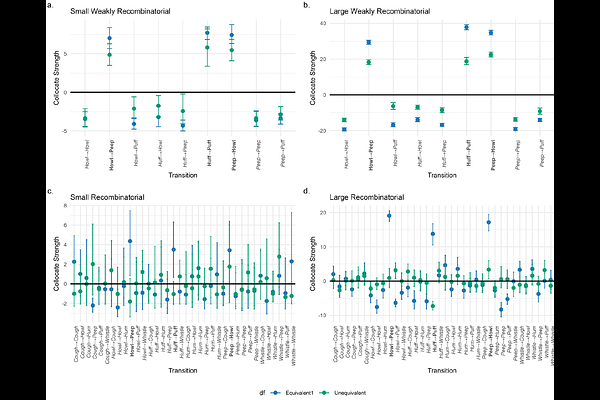
AbstractMany animals communicate using sequences of signals, but identifying recurrent, non-random signal combinations remains methodologically challenging. Collocation analyses are increasingly popular approaches for detecting which signals animals combine at rates greater than expected by chance. However, existing methods for animal collocation analysis face several limitations that reduce their statistical rigour: they lack uncertainty estimates, fail to control for non-independence in sampled data, and do not account for inflated family-wise error rates when identifying attraction among many different signal types. These limitations restrict the broader applicability of animal collocation analysis, including preventing robust comparisons of signal combination strength between cohorts (e.g. populations, sexes or age classes). We adapt a novel form of Multiple Distinctive Collocation Analysis using Pearson residuals (MDCA-Pr) that addresses these statistical limitations, and validate its use in animal communication research in three ways: first, using numerous simulated datasets of different sizes and levels of signal recombination; second, using simulated data to evaluate the performance of MDCA-Pr in intercohort comparisons, and third, by demonstrating how MDCA-Pr can be applied to compare the vocal sequences produced by male and female captive-living common marmosets (Callithrix jacchus). MDCA-Pr shows high sensitivity, including at small sample sizes, and generally low false-positive rates, which we further reduce by applying additional criteria for identifying attraction between signals. During intercohort comparisons, MDCA-Pr is conservative, with low false-positive rates, and statistical power increases with sample size. MDCA-Pr is a robust method for evaluating signal attraction in animal communication and enables accurate intercohort comparison of animal signal combinations.