Identifying Phelan-McDermid-Like Electrophysiological Subtypes in Autism Using EEG and Machine Learning

Identifying Phelan-McDermid-Like Electrophysiological Subtypes in Autism Using EEG and Machine Learning
Kohli, S.; Schaffer, E. S.; Savino, J.; Thinakaran, A.; Cai, S.; Halpern, D.; Zweifach, J.; Sancimino, C.; Siper, P. M.; Buxbaum, J. D.; Foss-Feig, J.; Kolevzon, A.; Beker, S.
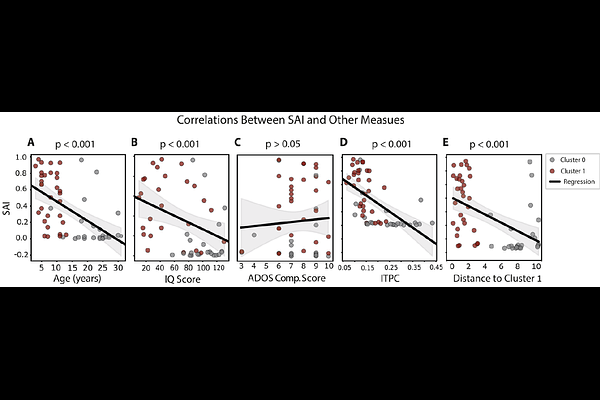
AbstractBackground: Phelan McDermid syndrome (PMS), caused by SHANK3 haploinsufficiency, is a genetic form of autism spectrum disorder (ASD) that provides a genetically defined model for studying ASD-related circuit dysfunction. SHANK3 mutations disrupt synaptic organization and cortical synchrony, leading to attenuated gamma-band auditory steady-state responses (ASSRs). We investigated whether PMS-related electrophysiological signatures could be identified using machine learning and whether similar patterns are present in a subset of individuals with idiopathic ASD (iASD). Methods: EEG recorded during a 40-Hz ASSR paradigm was collected from 123 participants (42 TD aged 2-30, 56 iASD aged 3-31, 25 PMS aged 2-26). We extracted time-series, ERSP, FOOOF-derived spectral, and intertrial phase coherence (ITPC) features. XGBoost models with leave-one-out cross-validation classified PMS versus TD; the best age/sex-adjusted ITPC model was then applied to iASD participants to derive a Synchrony Atypicality Index (SAI). Unsupervised clustering of high-dimensional ITPC features was also performed. Results: ITPC-based models showed the strongest discrimination between TD and PMS participants (AUROC = 0.83). When applied to iASD participants, 35.7% exhibited elevated SAI, indicating a PMS-like gamma-band phase-locking profile. Classification of iASD versus PMS performed poorly in the full sample but improved markedly after excluding high-SAI iASD individuals, consistent with substantial heterogeneity within iASD. Unsupervised clustering of ITPC features identified PMS-enriched clusters that also captured high-SAI iASD participants. Results were consistent after controlling for age in sensitivity analyses. Conclusions: Reduced 40-Hz ITPC is a mechanistically interpretable electrophysiological signature of PMS and identifies a biologically meaningful PMS-like subgroup within iASD, supporting biomarker-guided stratification.