Decoding social integration in schooling fish using closed-loop real-virtual interactions

Decoding social integration in schooling fish using closed-loop real-virtual interactions
Kang, Z.; Escobedo, R.; Combe, M.; Sanchez, S.; Sire, C.; Theraulaz, G.
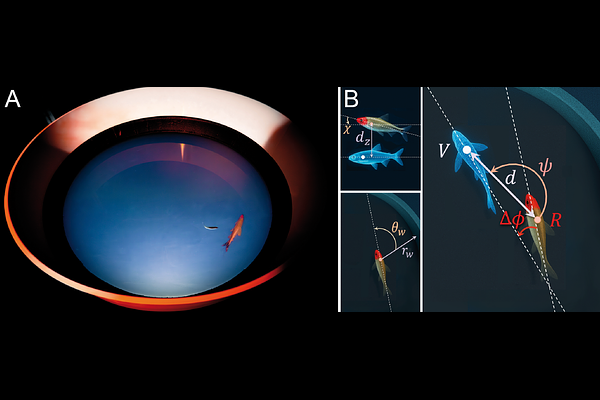
AbstractCollective motion in animal groups emerges from local interactions, yet how individuals select and integrate social information remains poorly understood. In schooling fish, inferring which neighbors drive an individual's behavior at any given moment is extremely challenging because the analysis of trajectories alone does not unambiguously reveal the underlying causal interactions that generate the observed motion. Here, we used a closed-loop virtual-reality system in which a single real rummy-nose tetra (Hemigrammus rhodostomus) interacted in real time with four model-driven virtual conspecifics whose interaction rules were precisely controlled. By systematically varying the number of influential neighbors of the virtual fish and combining experiments with simulations, we quantified how social information filtering shapes individual and collective dynamics. Collective coordination increased with stronger social coupling, but analyses of kinematics, spatial organization, correlations, and turning dynamics consistently showed that the real fish behaved as if it were responding primarily to the single most influential neighbor, whose identity could change over time. These results demonstrate that selective interaction with the most influential neighbor is sufficient to sustain coordinated group motion and highlight the power of bio-hybrid closed-loop experiments to reveal causal mechanisms of collective behavior.