Association of CRP and synovial fluid HMGB1 with Pain in Oligoarticular and Polyarticular Juvenile Idiopathic Arthritis: a cross-sectional study

Association of CRP and synovial fluid HMGB1 with Pain in Oligoarticular and Polyarticular Juvenile Idiopathic Arthritis: a cross-sectional study
Wen, X.; Rosmark, J.; Versteegen, A.; Sunderberg, E.; Altman, M.; Aulin, C.; Erlandsson Harris, H.
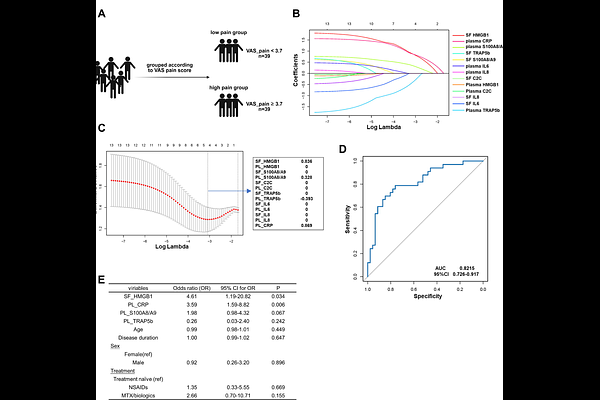
AbstractBackground: Pain is one of the most prevalent and distressing symptoms in juvenile idiopathic arthritis (JIA) and often persists despite treatment. Damage-associated molecular patterns (DAMPs), such as high mobility group box 1 (HMGB1) and S100A8/A9, have been implicated in inflammatory activation and nociceptive sensitization, but their associations with pain are not fully characterized in JIA. Methods: Plasma and paired synovial fluid (SF) samples were obtained from patients with oligoarticular and polyarticular JIA from the Juvenile Arthritis Biobank (JABBA). A discovery cohort (n = 79) was used to investigate associations between biomarkers and pain, and these associations were subsequently examined in a validation cohort (n = 38). Levels of HMGB1, S100A8/A9, IL6, IL8, C2C, and TRAP5b were measured using ELISA. Associations between biomarkers and patient-reported pain scores were assessed using multivariable linear regression analyses. Results: Plasma and SF levels of most biomarkers did not show significant correlations, except for TRAP5b, which demonstrated a moderate correlation. In the discovery cohort, as multivariable linear regression analyses, both CRP and SF HMGB1 (beta= 1.14, 95% CI: 0.21-2.08; beta = 1.54, 95% CI: 0.06-3.01 respectively in fully adjusted model) were independently associated with higher pain scores. SF S100A8/A9 (beta = 1.00, 95% CI: 0.10-1.89) was additionally associated with pain in fully adjusted models. Sensitivity analyses confirmed the robustness of these findings. These associations were further supported in the validation cohort. Conclusions: Pain in JIA is associated with both systemic CRP and local alarmin markers, with SF HMGB1 showing a particularly robust association. These findings highlight the importance of local joint HMGB1 in pain mechanisms and suggest a potential role for DAMP-mediated pathways in persistent pain in JIA. Keywords: Juvenile idiopathic arthritis, pain, biomarker, HMGB1.