Consolation behaviour in pigs: Prior exposure to group members in need of help drives targeted affiliation and facilitates social buffering

Consolation behaviour in pigs: Prior exposure to group members in need of help drives targeted affiliation and facilitates social buffering
Lopez Caicoya, A.; Janicka, W.; Moscovice, L. R.
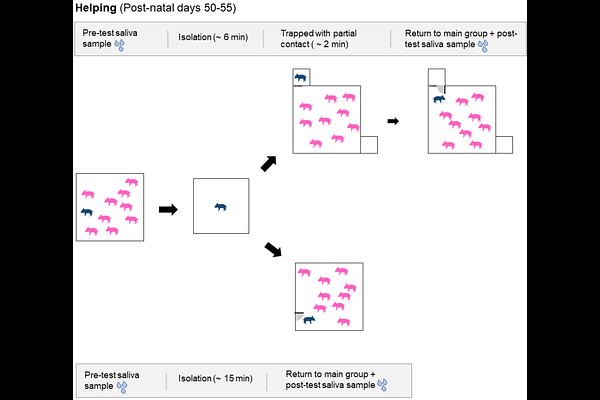
AbstractWe assessed whether pigs provide consolation, referring to targeted affiliation that attenuates a partner's stress, under experimental conditions that manipulated exposure to stressed partners. Using a within-subject design, 74 pigs were tested in three contexts: a helping task in which group members could observe and help a trapped focal pig to return to the group, a direct-reunion, in which group members were naive to the experience of a separated focal pig until reunion, and an undisturbed control. We measured affiliative and non-affiliative interactions, anxiety behaviours and changes in salivary cortisol. Only the helping context satisfied most consolation criteria: there were selective increases in unidirectional affiliative contacts from the observer to the focal pig, non-affiliative interactions remained at baseline, and focal pigs showed fewer anxiety behaviours. In contrast, direct-reunions triggered increases in affiliative and non-affiliative interactions and higher anxiety. Cortisol increased during both direct-reunions and helping, but its level was not linked to affiliation. Results add to growing evidence for consolation behaviour in pigs and suggest best practices for reintegrating pigs into groups. Graded reintroductions that allow observers to assess the emotional state of targets may promote social buffering, whereas abrupt regrouping may trigger more generalized arousal or personal distress.