MEN1 deficiency establishes a selenite-dependent binary switch in ferroptosis

MEN1 deficiency establishes a selenite-dependent binary switch in ferroptosis
Low, R. R. J.; Parnandi, N.; Idilli, A. I.; Gjelaj, E.; Subtil, F. T.; Segura-Bayona, S.; MacRae, J. I.; Boulton, S. J.
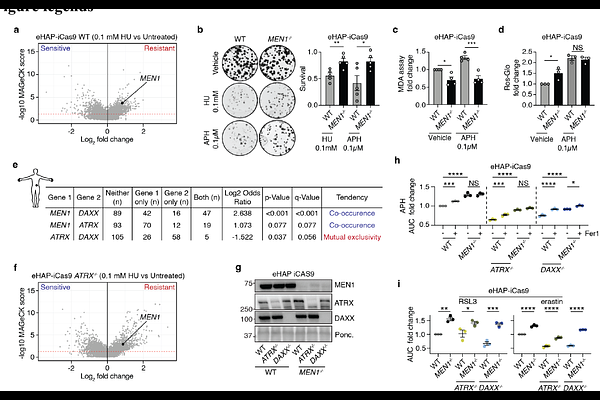
AbstractReplication stress is a driver of cancer cell death, yet how genetic and environmental factors impact cellular tolerance remains unclear. Here, we identify the loss of the chromatin scaffold MEN1 as a determinant of replication stress resistance and show that this phenotype arises from suppression of ferroptosis. MEN1-deficient cells exhibit reduced expression of ACSL1 and SLC7A11, creating an intrinsic ferroptosis-sensitized state. Unexpectedly, this vulnerability is masked by environmental selenium, which drives GPX4 upregulation independently of SLC7A11. As a result, MEN1 deficiency establishes a selenium-dependent binary switch between ferroptosis hypersensitivity and resistance, which dictates cellular responses to replication stress. Mechanistically, this state is regulated by an H3.3-dependent transcriptional program linking chromatin remodeling to lipid and redox metabolism. These findings reveal that micronutrient availability can override genetically encoded cell-death programs and uncover a context-dependent vulnerability in MEN1 mutant cancers.