Carbon-negative biosynthesis of pyrone and pyridine dicarboxylic acids from terephthalic acid via continuous mixotrophic gas fermentation in Cupriavidus necator H16

Carbon-negative biosynthesis of pyrone and pyridine dicarboxylic acids from terephthalic acid via continuous mixotrophic gas fermentation in Cupriavidus necator H16
Waters, E.; Conradie, A.; Bommareddy, R. R.
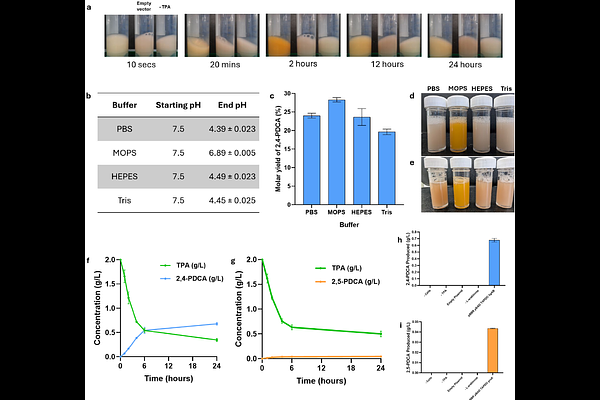
AbstractIndustrial defossilisation requires carbon-negative routes for sustainable chemical production. Bioprocesses based on renewable feedstocks are often constrained by biogenic CO2 emissions, reducing yields and undermining environmental performance. Here, we report a mixotrophic gas fermentation strategy using the chemolithoautotroph Cupriavidus necator H16 that simultaneously assimilates CO2 for cell growth and biocatalyst generation while converting the PET monomer terephthalic acid (TPA) into value-added biopolymer precursors. This process achieved complete conversion of TPA to 2-pyrone-4,6-dicarboxylic acid (PDC) with titres of 24.5 g/L and a productivity of 0.47 g L-1 h-1. Conversion to pyridine dicarboxylic acids (2,4- and 2,5-PDCA) was less efficient (~22% and ~4% respectively) due to metabolic limitations such as intermediate toxicity and pH-dependent spontaneous cyclisation. Our results establish the first carbon-negative route coupling simultaneous CO2 assimilation with plastic monomer valorisation, providing a blueprint for sustainable biomanufacturing aligned with global climate and circular economy goals.