Towards End-to-End Quantum Estimation of Non-Hermitian Pseudospectra

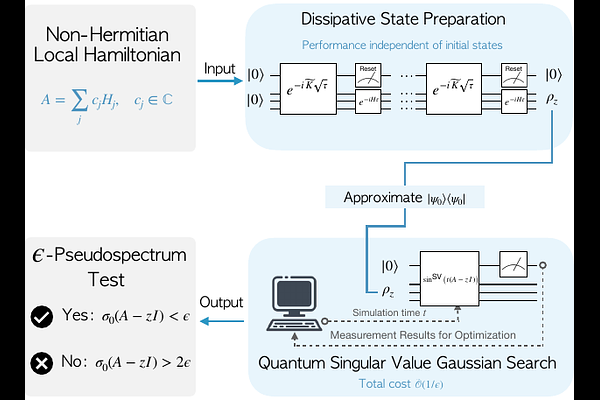
Towards End-to-End Quantum Estimation of Non-Hermitian Pseudospectra
Gengzhi Yang, Jiaqi Leng, Xiaodi Wu, Lin Lin
AbstractNon-Hermitian many-body systems can be spectrally unstable, so small perturbations may induce large eigenvalue shifts. The pseudospectrum quantifies this instability and provides a perturbation-robust diagnostic. For inverse-polynomially small $ε$, we show that deciding whether a point $z\in\mathbb{C}$ is $ε$-close to the spectrum is PSPACE-hard for $5$-local operators, whereas deciding whether $z$ lies in the $ε$-pseudospectrum is QMA-complete for $4$-local operators. This identifies pseudospectrum membership as a natural computational target. We then present a concrete end-to-end quantum framework for deciding pseudospectrum membership, which combines a singular-value estimation step with a dissipative state preparation algorithm. Our Quantum Singular-value Gaussian-filtered Search (QSIGS) combines quantum singular value transformation (QSVT) with classical post-processing to achieve Heisenberg-limited query scaling for singular-value estimation. To prepare suitable input states, we introduce an algorithmic Lindbladian protocol for approximate ground right singular vectors and prove its effectiveness for the Hatano--Nelson model. Finally, we demonstrate the full pipeline on a trapped-ion quantum computer and distinguish points inside and outside the target pseudospectrum near the exceptional point of a minimal non-Hermitian qubit model.