Reconstructing the human enhancer RNA transcriptome

Reconstructing the human enhancer RNA transcriptome
Benova, N.; Kuklinkova, R.; Ibenye, E.; Boyne, J. R.; Anene, C. A.
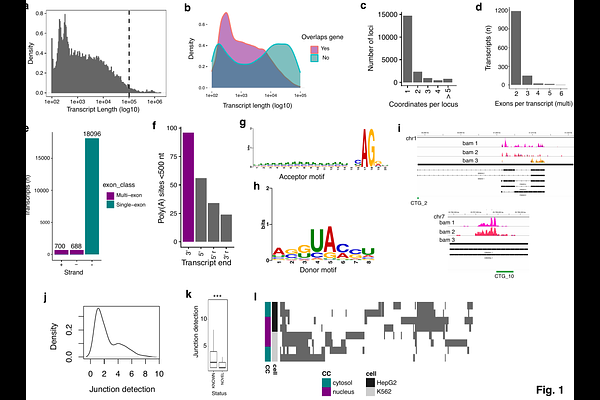
AbstractTranscript-resolved models of RNA enable functional interrogation of RNA biology by linking processing, structure, localisation, and regulatory interactions to specific RNA molecules. Across coding and noncoding transcriptomes, such models have been essential for defining RNA-level mechanisms relevant to physiology and disease. Enhancer RNAs (eRNAs), however, remain largely characterised without transcript-level definitions, and no widely adopted transcript-resolved reference exists, limiting investigation of how individual eRNAs are processed, localised, and participate in transcriptional regulation or their emerging post-transcriptional functions. Here, we reconstruct a transcript-resolved catalogue of human eRNAs by pan-transcriptome assembly across diverse tissues, cell types and compartments, defining 36,536 transcripts, including a subset with multi-exonic structure. We show that eRNA splice junctions are reproducible features that exhibit cell-type specificity, subcellular localisation bias, and sensitivity to spliceosome perturbation. In perturbation experiments, eRNA splice junction usage responded to SF3B1 mutation, nuclear-cytoplasmic partitioning, and pharmacological inhibition of RNA export, demonstrating regulation across multiple layers of RNA biology. In head and neck squamous cell carcinoma, a subset of these junctions showed altered usage between tumour and matched normal tissue, indicating that processing varies in disease contexts. Across three validation contexts, nearly one-fifth of reconstructed junctions were detectable, with some showing regulated usage, supporting biological reproducibility. Motivated by these observations, we provide both the GTF annotation and junctions BED file, as a framework for studying eRNAs, enabling RNA-centric investigation of their potential functions. The annotations have been incorporated into the eRNAkit database, available at https://github.com/AneneLab/eRNAkit.