FLD Is Required for N-Hydroxypipecolic Acid Accumulation and Associated Growth Defects in Arabidopsis pmr4 Mutant

FLD Is Required for N-Hydroxypipecolic Acid Accumulation and Associated Growth Defects in Arabidopsis pmr4 Mutant
Fan, B.; Chen, Z.
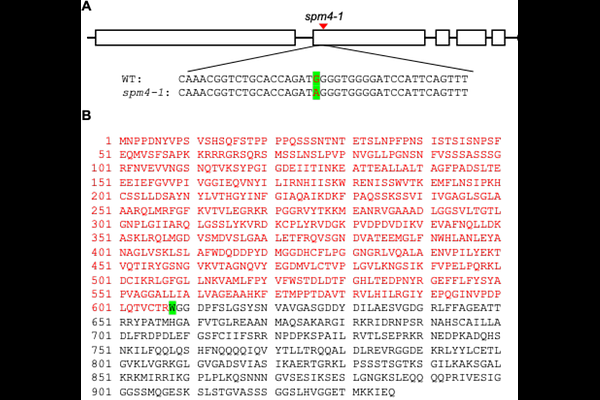
AbstractThe Arabidopsis mutants lacking the pathogen-inducible callose synthase POWDERY MILDEW RESISTANCE 4 (PMR4)/GLUCAN SYNTHASE-LIKE 5 (GSL5) exhibit enhanced disease resistance accompanied by reduced growth, spontaneous necrosis, and premature senescence. This autoimmune phenotype of pmr4 is associated with a high accumulation of N-hydroxypipecolic acid (NHP) and a moderate increase in salicylic acid. We previously reported three suppressors of pmr4 (spm), PAD4 and the NHP biosynthetic genes ALD1 and FMO1, whose loss-of-function mutations abolish NHP accumulation and completely suppress the growth defects of pmr4, demonstrating that NHP is critical to the autoimmune growth phenotype. Here, we characterize a fourth suppressor, spm4, which similarly fully suppresses the growth defects of pmr4. Map-based cloning and molecular genetic analyses revealed that spm4 carries a mutation in FLOWERING LOCUS D (FLD). Reintroduction of a wild-type FLD allele into the pmr4 spm4 background restored both NHP accumulation and the characteristic growth defects of pmr4. Conversely, independent FLD loss-of-function alleles generated by CRISPR/Cas-mediated genome editing suppressed NHP accumulation and rescued the autoimmune growth defects of pmr4, confirming that FLD is required for manifestation of the pmr4 phenotype. Beyond its established role in flowering-time regulation, FLD has been implicated in plant immunity, particularly in systemic acquired resistance (SAR), although the mechanistic basis of its immune function remains poorly understood. Our findings identify FLD as an essential positive regulator of NHP accumulation, thereby providing a mechanistic link between FLD-dependent epigenetic regulation, NHP-mediated signaling, and SAR.