The Depletion of Collisionless Dark Matter Spikes

The Depletion of Collisionless Dark Matter Spikes
Charlie Sharpe, Yonadav Barry Ginat, Thomas F. M. Spieksma, Bence Kocsis
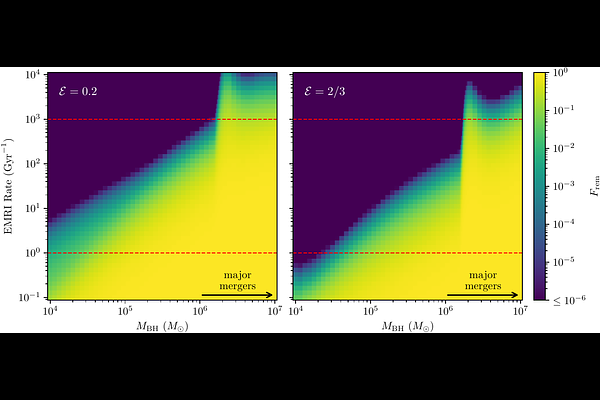
AbstractDense concentrations of dark matter (DM) surrounding black holes provide a compelling opportunity to probe the nature of DM. In the classic Gondolo-Silk model, the adiabatic growth of a massive black hole (MBH) in a DM cusp produces a steep density spike ($ρ\propto r^{-7/3}$), potentially inducing measurable gravitational-wave dephasings in intermediate and extreme mass-ratio inspirals (IMRIs/EMRIs). We challenge this paradigm by considering a collisionless spike embedded in a realistic nuclear star cluster (NSC). Using 1D orbit-averaged Fokker-Planck (FP) simulations of isotropic NSCs, we show that mass segregation in a multi-mass stellar cusp accelerates relaxation, relative to single-mass models, thereby driving the DM to the lower density $r^{-3/2}$ Bahcall-Wolf profile within $\lesssim 1 \mathrm{Gyr}$. In the inner regions, where the FP description breaks down, we model strong triple interactions between DM particles and EMRIs using post-Newtonian 3-body simulations. We show that EMRIs eject DM particles via slingshots, depleting the inner spike over a few Gyrs. Because EMRI number densities are too low to drive two-body relaxation, and collisionless DM cannot efficiently repopulate the depleted phase space, this depletion is irreversible. While the extent of EMRI-induced depletion depends on the EMRI rate and mass, we find reductions in DM densities by several orders of magnitude. Hence, DM-induced dephasings for EMRIs may fall below the detectability threshold of LISA for MBHs at $z = 3$ (2.14 Gyr) with masses $\lesssim 10^{5}\,M_\odot$ (for an $\mathcal{O}(10) \, \mathrm{Gyr}^{-1}$ EMRI rate), extending to $\lesssim 10^6\,M_\odot$ for more optimistic rates of $\mathcal{O}(300-1000) \, \mathrm{Gyr}^{-1}$. Our findings substantially reduce the parameter space over which MBHs can host detectable collisionless DM spikes.