Deep tissue removal in wounds facilitates algal colonization and inhibits healing and regeneration in tropical corals

Deep tissue removal in wounds facilitates algal colonization and inhibits healing and regeneration in tropical corals
Seifert, A. W.; Brzezinski, M.; Osenberg, C. W.; Stier, A. C.
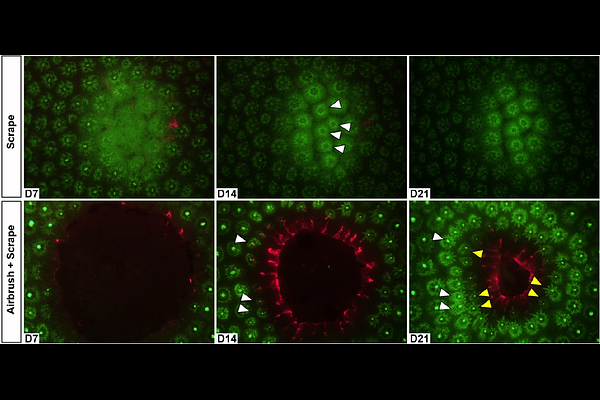
AbstractAlthough corals are highly regenerative, some colonies in reef ecosystems completely recover from sublethal damage while other colonies exhibit partial mortality to similar injuries. To understand factors that might naturally curtail regenerative ability, we experimentally wounded small colonies in three coral genera (Acropora, Pocillopora, Porites) by mimicking natural corallivory using scraping (tissue and skeletal damage) or airbrushing (deep tissue removal with no skeletal injury). We found all scraped wounds regenerated rapidly in Acropora and Porites, while Pocillopora fragments frequently retained open lesions. In stark contrast, airbrushing resulted in algal colonization and delayed tissue healing and regeneration across all corals. Detailed cellular analysis of Porites wounds revealed two general phases comprising tissue regeneration: a healing phase defined by rapid coverage of bare skeleton with coenosarc, pigment cells and gastrodermal reformation, and then a second phase lasting one week ending in polyp regeneration. Red fluorescence appeared transiently in scrape wounds but persisted in tissue at the wound margin surrounding algae in airbrush wounds, suggesting that algal occupation of the wound bed inhibits coenosarc healing. Lastly, histological cross-sections of healing airbrush wounds in Porites revealed progressive loss of deep tissue leading to skeletal breakdown beneath the wound. Together, our results demonstrate the biphasic nature of tissue regeneration in colonial corals and provide a framework for understanding how biotic factors impact tissue repair and regeneration in nature.