Charged black holes embedded in matter with anisotropic pressure: Horizon Structure and Quasinormal Mode Spectra

Charged black holes embedded in matter with anisotropic pressure: Horizon Structure and Quasinormal Mode Spectra
D. N. Garzon, Jiayi Zhang, Elena Kopteva, Helvi Witek
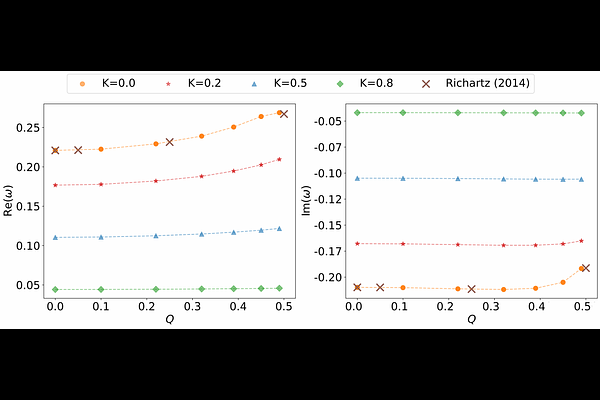
AbstractIn realistic settings, black holes are expected to be embedded in astrophysical environments. These environments, including possible dark matter distributions, can modify observable properties of black holes and leave imprints on their quasinormal mode spectra. In this work, we model the environment as matter with anisotropic pressure, and we consider a charged black hole embedded in it. The resulting spacetime is described by the Kiselev metric. We first analyze its horizon structure. We then investigate the quasinormal modes of a massless charged scalar field propagating on this background. For this purpose, we develop a nontrivial extension of Leaver's continued fraction method to incorporate the effects of the surrounding matter, and we combine this framework with automatic differentiation techniques. We also compare our results to those obtained with the sixth-order Wentzel-Kramers-Brillouin approximation. We find that the surrounding matter modifies the oscillation frequencies and damping rates and leads to the appearance of long-lived modes. We also identify avoided crossings regions and reorganization of the modes in the spectra. Our results demonstrate the importance of incorporating surrounding matter when modeling realistic black holes. The numerical framework we developed here provides a tool for studying quasinormal modes in non-vacuum spacetimes and can be extended to a broad class of black-hole geometries embedded in matter fields.