Structural signatures of synergy and redundancy in human brain function

Structural signatures of synergy and redundancy in human brain function
Barjuan, L.; Pope, M.; Serrano, M. A.; Sporns, O.
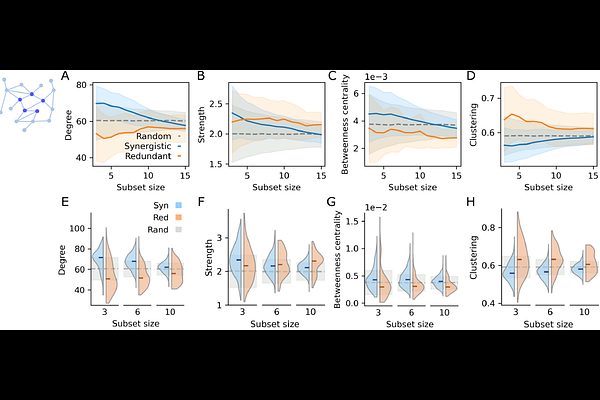
AbstractA fundamental goal in neuroscience is to understand how the brain's physical architecture supports complex functional dynamics. While the relationship between structural connectivity and pairwise functional connectivity has been extensively studied, the anatomical basis of higher-order interactions remains poorly understood. In this study, we use multivariate information theory, specifically the O-information, to investigate how the human connectome constrains subsets of brain regions characterized by predominantly redundant or synergistic information sharing. By analyzing the topology and community embedding of these subsets, we reveal two different structural profiles. Redundant subsets are characterized by high internal connection density and strong weights. Their nodes have high clustering and occupy globally less central positions. In contrast, synergistic subsets consist of globally central nodes with high betweenness centrality. We further demonstrate that leveraging these structural features, in particular node centrality, significantly improves the identification of synergistic subsets compared to random sampling. Together, these results demonstrate that the human connectome imposes specific constraints on higher-order information sharing, extending structure-function relationships beyond pairwise interactions and providing new insight into the structural origins of multivariate functional organization.