Nuclear envelope-dependent heterochromatin positioning gates the timing of nucleolar assembly in the early embryo

Nuclear envelope-dependent heterochromatin positioning gates the timing of nucleolar assembly in the early embryo
Ding, X.; Wang, G.; Elnatan, D.; Laurence, M.; Zdanovskis, S.; Couture, M.; Weber, S. C.; Starr, D.; Luxton, G. G.
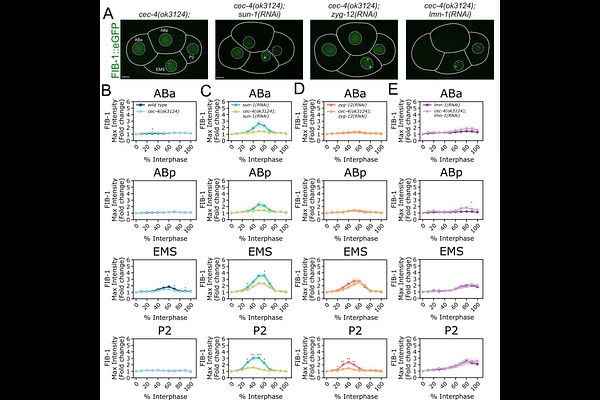
AbstractThe nucleolus is the largest nuclear condensate, yet how its assembly is developmentally timed remains poorly understood. In the Caenorhabditis elegans embryo, nucleoli normally appear at the 6- to 8-cell stage. Here we show that the LINC complex and nuclear lamina restrain premature nucleolar assembly through heterochromatin organization. Depletion of the embryonic LINC complex proteins SUN-1 or ZYG-12 induces precocious FIB-1-positive nucleoli at the 4-cell stage, particularly in the EMS and P2 blastomeres. LMN-1 depletion produces a more severe phenotype combining premature assembly with impaired disassembly. Loss of the heterochromatin anchor CEC-4 alone has modest effects but strongly suppresses precocious nucleolar assembly caused by LINC complex depletion. LINC complex and lamin perturbations alter the heterogeneity of HPL-2-marked chromatin, and FIB-1 condensates occupy locally HPL-2-depleted regions. These findings identify nuclear envelope-dependent heterochromatin organization as a developmental gate for nucleolar condensate assembly.