Inferring Cell-Cell Interaction Dynamics from Cell Trajectory Data Using Deep Attention Networks

Inferring Cell-Cell Interaction Dynamics from Cell Trajectory Data Using Deep Attention Networks
Boyle, J.; Baker, R. E.; Byrne, H. M.
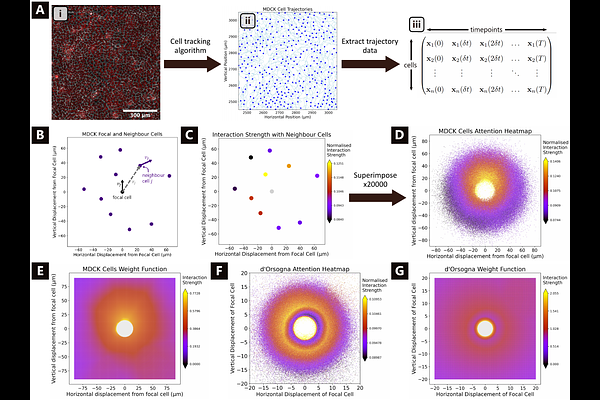
AbstractInteractions between nearby cells are a key driver of cell movement in many biological systems, including collective cell migration and the immune response to cancer. However, inferring the interaction rules in a given system in a manner that is both accurate and biologically interpretable remains a challenge. A valuable experimental method for analysing cell-cell interaction dynamics is the tracking of individual cell locations over a series of time-lapse images, and in this work we present a model, based on the theory of deep attention networks, that learns how cell-cell interactions affect cell movement directly from cell trajectory data. Our approach requires no a priori assumptions about the mechanisms governing cell behaviour, enabling it's application to cell trajectory data originating from a diverse range of biological systems. In addition to the model, we develop a suite of tools that exploit the model's attention-based structure to present the learned interaction dynamics in an interpretable manner. Our model extends previous applications of deep attention networks to cell movement by providing deeper insights into cell-cell interaction dynamics, moving beyond inferring whether cells interact to inferring how these interactions affect cell movement, and providing the ability to infer type dependent cell-cell interaction dynamics in multi-type cell movement systems. By combining data-driven learning and structural interpretability, our approach represents a highly general methodology for linking cell trajectory data to mechanistic hypotheses, showing that deep attention networks constitute a powerful exploratory tool for characterising the effect of cell-cell interactions on cell movement in complex cellular systems.