Rab4 and Rab11 GTPases cooperate to reinforce adherens junctions at the leading edge to promote rapid embryonic wound healing

Rab4 and Rab11 GTPases cooperate to reinforce adherens junctions at the leading edge to promote rapid embryonic wound healing
O'Donnell, B. D.; Mendez-Lopez, S.; MacQuarrie, K.; Fernandez-Gonzalez, R.; Rothenberg, K. E.
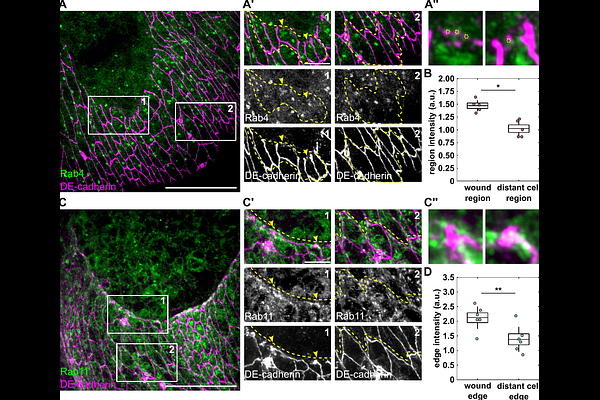
AbstractCollective cell movements drive the formation and repair of tissues and contribute to the spread of metastatic disease. Cells must remodel their cell-cell adhesions and actomyosin cytoskeleton to enable migration, but the mechanisms that drive these molecular rearrangements are unclear. We used wound healing in the Drosophila embryonic epidermis to investigate these mechanisms. Upon wounding, a supracellular cable composed of actin and myosin assembles around the wound. In parallel, adherens junction proteins, including E-cadherin, are depleted from the wound edge via endocytosis and accumulate at former tricellular junctions around the wound (wTCJs) through unknown mechanisms. We found that the small GTPases Rab4 and Rab11, implicated in endosomal trafficking, are necessary for rapid wound repair. Manipulations of Rab4 and Rab11 activity reduced wound closure rates but did not have effects on tissue mechanics or myosin polarization that could explain the defect. Instead, Rab4 and Rab11 redistributed E-cadherin to accumulate at wTCJs in a process necessary for collective cell movement. Together, our results show that adherens junction reinforcement via endosomal recycling is a key step of coordinated cell migration that controls the rate of wound healing independent of cytoskeletal remodeling.