Testing the ${\rm ER=EPR}$ conjecture with entangled photons

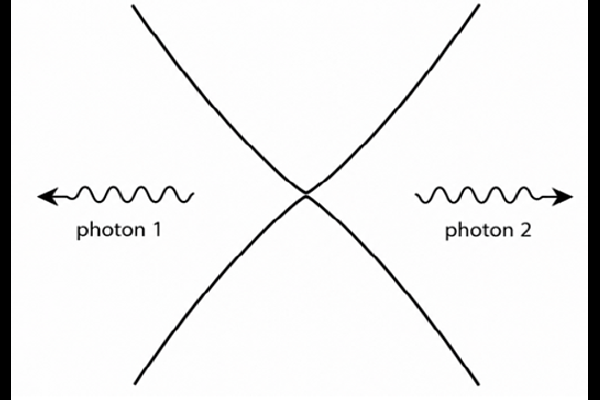
Testing the ${\rm ER=EPR}$ conjecture with entangled photons
Kimet Jusufi, Francisco S. N. Lobo, Douglas Singleton
AbstractWe regularize the Aichelburg-Sexl shock-wave metric for massless particles by smearing the point-like source over a string-inspired length scale $l_0$, obtaining a singularity-free gravitational potential. A coordinate transformation reveals that the transverse geometry is a zero-throat Einstein-Rosen wormhole, providing an explicit geometric realization of the ER=EPR conjecture for entangled photons. Crucially, we show that the gravitational self-energy depends on the photon's longitudinal extent $L$ (its wavelength) and, for a transversely separated photon pair, is suppressed by a factor $1/L$, giving $E^{\rm GSE}\sim 4G(\hbarω)^2/(c^4 L)\ln(d^2/l_0^2)$. For the coincident back-to-back pair created in $e^{+} e^{-}\to2γ$, the wormhole carries no additional binding energy; the logarithmic interaction energy emerges only after the entangled photons separate to a distance $d$, stretching the ER bridge. We further provide an entanglement-entropy interpretation: by computing the entanglement entropy of null intervals in the shock-wave geometry and introducing an effective entanglement temperature $k_B T_{\rm ent}\sim\hbar c/(2πL)$, we recover the same scaling and normalization of the gravitational self-energy. For optical photons the corresponding collapse time exceeds $10^{30}$ years, making isolated photons immune to gravity-induced wave-function collapse. These findings establish a rigorous playground for testing ER=EPR and reveal a deep suppression of quantum-gravity effects for ultra-relativistic quanta.