Physiological re-replication during human stem cell differentiation

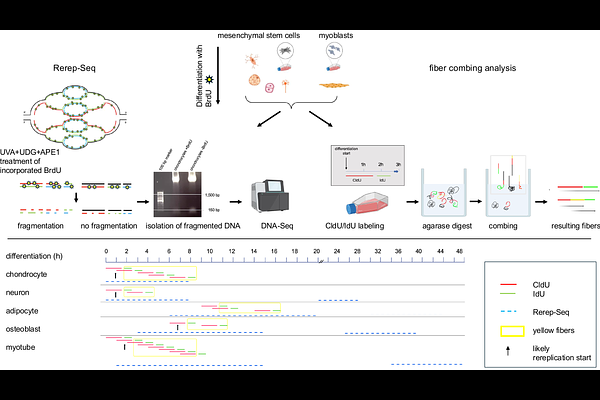
Physiological re-replication during human stem cell differentiation
Minet, M.; Beganovic, A.; Rishik, S.; Michaeli, E.; Yildiz, D.; Schmartz, G. P.; Schwarz, P. E.; Schaefer, M.; Taenzer, T.; Cucchiarini, M.; Ludwig, N.; Keller, A.; Meese, E.; Fischer, U.
AbstractDuring defined developmental windows in Drosophila, controlled re-replication generates physiological gene amplification. Although gene amplification has also been observed during human stem cell differentiation, re-replication in human cells has largely been linked to tumor-associated genome instability. Here, we demonstrate that re-replication likewise operates as a physiological mechanism in human stem cells. Using Rerep-Seq and DNA fiber-combing, we identify distinct phases of re-replication during the differentiation of human myoblasts into myotubes and during the lineage commitment of mesenchymal stem cells toward adipogenic, osteogenic, chondrogenic, and neuronal fates. In all differentiation systems examined, re-replication occurred within defined temporal windows. FACS-isolated re-replicating cells exhibited elevated gene expression using RNA-Seq specifically within re-replicated genomic regions. Moreover, re-replicated DNA was detected as extranuclear DNA. These findings support a model in which cells that do not undergo re-replication, and thus avoid increased chromosomal instability, may nonetheless boost the expression of differentiation-relevant genes by acquiring re-replicated DNA released from neighboring re-replicating cells. We propose that human stem cells exploit an evolutionarily conserved re-replication mechanism to transiently increase gene copy number and thereby meet the heightened protein demands associated with differentiation.