Shroom3-dependent pillar cell constriction establishes a mechanical threshold for respiratory lamellar stability

Shroom3-dependent pillar cell constriction establishes a mechanical threshold for respiratory lamellar stability
Preussner, M.; Kahler, A.; Basoglu, M.; Mertens, A.; Krause, D. S.; Eimer, S.; Lecaudey, V.
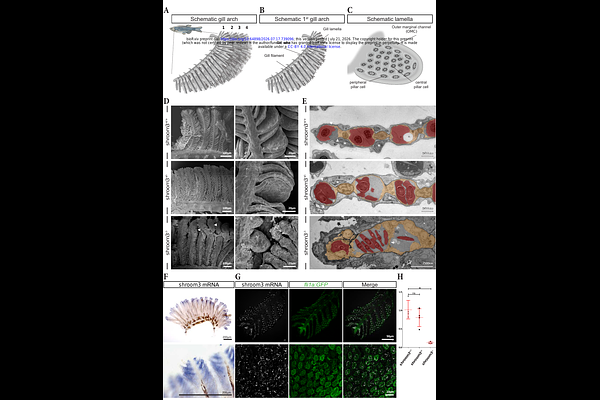
AbstractHow developing organs acquire complex architectures while maintaining tissue integrity under mechanical stress is a fundamental question in mechanobiology. In the gill, pillar cells support the thin respiratory lamellae, but how they withstand hemodynamic forces is unknown. Here, we show that actomyosin-rich contractile apparatuses (CA) in zebrafish pillar cells act as load-bearing units that generate contractile forces and stabilize the lamella through adhesion to and enclosure of extracellular collagen columns. CA number correlates with pillar cell constriction, linking subcellular architecture to tissue geometry. We further identify Shroom3 and Vinculin b as key regulators of CA assembly and force transmission: shroom3 deficiency or loss of vclb impairs CA formation and reduces pillar cell constriction, while loss of shroom3 causes lamellar collapse. Together, these findings support a mechanical threshold model in which lamellar integrity depends on a minimum number of CAs per pillar cell and establish the gill lamellae as a model for linking subcellular contractility to tissue-scale mechanical stability.