Age- and Light-Dependent Changes in the Zebrafish Olfactory Epithelium

Age- and Light-Dependent Changes in the Zebrafish Olfactory Epithelium
Chapman, G. B.; Abutarboush, R.; Connaughton, V. P.
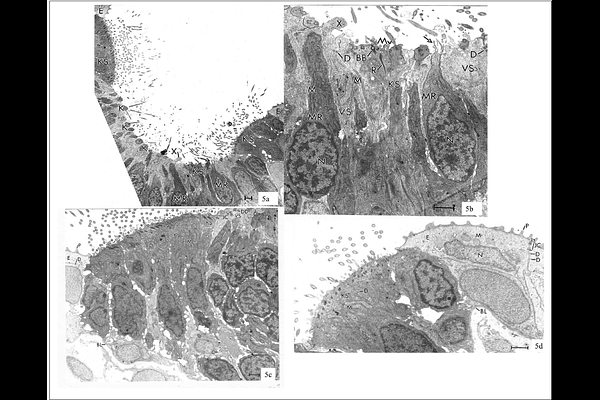
AbstractLight and transmission electron microscopy were used to identify changes in ultrastructure of the olfactory pit of larval zebrafish (Danio rerio) that occur as a result of age and altered environmental light levels. Larvae were reared under control/cyclic light or constant light condition until 4, 8, and 15 days postfertilization (dpf). The larval olfactory pit consisted of an epithelium that varies from simple to pseudostratified to stratified and contained three types of receptor cells: ciliated, microvillar and ciliated crypt. A variety of non-receptor cells were also identified: kinociliate non-sensory supporting cells, vesicular supporting cells, basal cells and an occasional intruder, such as a neutrophil or a lymphocyte. Microvilli projecting from microvillus receptor, kinociliate, and vesicular supporting cells were single, forked, or doubly forked. Junctional complexes were evident between a variety of cells including adjacent epidermal cells, an epidermal cell and a kinociliate cell, a kinociliate and a vesicular supporting cell, and two vesicular supporting cells. Desmosomes were also observed between adjacent cell types. With age, the olfactory epithelium thinned and vesicle number varied. In larvae reared in constant light, mitotic figures were evident, microvillar receptor cells were absent, and, at 4 dpf, some ultrastructural components were similar to those observed in 8 dpf control animals, suggesting precocious development. These findings suggest that constant light rearing alters the timing of receptor replacement, supporting previous work showing that rearing light levels impact sensory system growth and development.