Bovine H5N1 influenza viruses have adapted to more efficiently use receptors abundant in cattle

Bovine H5N1 influenza viruses have adapted to more efficiently use receptors abundant in cattle
Hassard, J. A.; Yang, J.; Dadonaite, B.; Pekar, J. E.; Yu, J.; Richardson, S. A. S.; Pinto, R. M.; Ramirez Valdez, K.; Lemey, P.; Quantrill, J. L.; Xue, J.; Masonou, T.; Case, K.-M.; Ajeian, J.; Woodall, M. N. J.; Ross, R. A.; Hudson, N.; Zhong, K.; Cao, H.; Jones, S.; Klim, H. J.; Wasik, B. R.; Dermawan, D. N.; Sadeyen, J.-R.; Werling, D.; Yaffy, D.; James, J.; Nunez, A.; Digard, P.; Brown, I. H.; Goldhill, D. H.; Murcia, P. R.; Smith, C. M.; Liu, Y.; Bloom, J. D.; Iqbal, M.; Barclay, W. S.; Haslam, S. M.; Peacock, T. P.
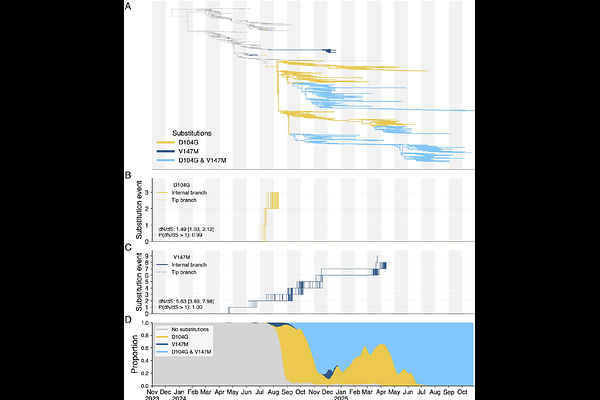
AbstractSustained mammal-to-mammal transmission of high pathogenicity H5N1avian influenza viruses is reshaping the host range of these pathogens. One of the longest-running mammalian transmission chains involves the B3.13 genotype circulating in U.S. dairy cattle which was detected early in 2024. Genomic analysis revealed selection and rapid fixation of haemagglutinin mutations D104G and V147M. We demonstate, via glycomic profiling, that bovine tissues, including the mammary gland, are enriched in N- and O-linked glycans capped with N-glycolylneuraminic acid (NeuGc), a sialic acid absent in humans and birds, which instead express only N-acetylneuraminic acid (NeuAc). Early cattle H5 viruses poorly recognized NeuGc, but D104G and V147M enabled efficient engagement of both NeuAc- and NeuGc-containing receptors. These mutations enhanced replication in bovine mammary tissue without major attenuation of replication in human lung and primary nasal epithelial cells. NeuGc-driven receptor adaptation therefore promotes viral fitness in cattle while potentially limiting immediate zoonotic risk. Deep mutational scanning further identifies alternative haemagglutinin substitutions that confer NeuGc usage and represent surveillance markers for emerging cattle H5 lineages.