Inositol phosphates, pyrophosphates and the genes involved in their turnover in the streptophyte green alga Chara braunii

Inositol phosphates, pyrophosphates and the genes involved in their turnover in the streptophyte green alga Chara braunii
Hess, D. A.; Shukla, A.; Jessen, H.; Hess, W. R.
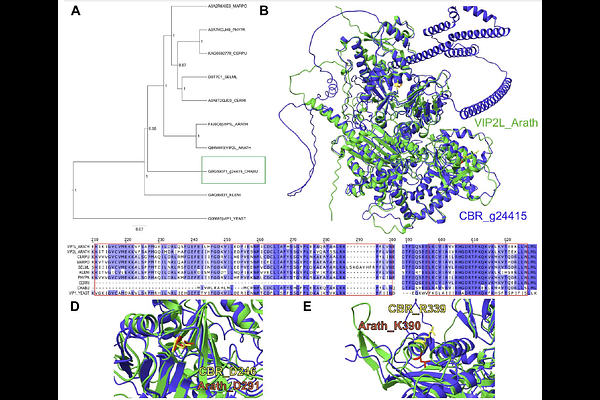
AbstractInositol phosphates (InsPs) and inositol pyrophosphates (PP-InsPs) are conserved signalling molecules, but their evolutionary origin and diversification in the green lineage remain poorly understood. Here we investigated the InsP network in the streptophyte alga Chara braunii, a key lineage close to the origin of land plants. Using capillary electrophoresis-electrospray ionization mass spectrometry, we detected a broad spectrum of InsP and PP-InsP species from InsP3 to InsP8, including multiple positional isomers. Developmental profiling across dormant oospores, young thalli and mature thalli revealed extensive metabolic remodeling, with InsP6 as the dominant metabolite and distinct stage-dependent changes in lower InsPs and pyrophosphorylated species. Multiple PP-InsP5 and (PP)2-InsP4 isomers were identified, together with an unassigned additional InsP8-like signal, indicating further pathway complexity. Bioinformatic analyses identified candidate homologs of major InsP metabolic enzymes, supporting the presence of an enzymatic framework for InsP synthesis and turnover similar to land plants. Environmental perturbation revealed isomer-selective effects: prolonged light and dark phases strongly affected the accumulation of specific InsP5 and PP-InsP5 isomers, with 1-PP-InsP5 emerging as the most stimulus-responsive pyrophosphate species, whereas heat stress preferentially reduced 4-PP-InsP5. Together, these findings show that a structurally complex and environmentally responsive InsP network was already established in streptophyte algae before the emergence of land plants.