Convergence of the quasinormal-mode expansion of the Kerr Green function

Convergence of the quasinormal-mode expansion of the Kerr Green function
Davide Ciattaglia, Adrien Kuntz, Enrico Barausse
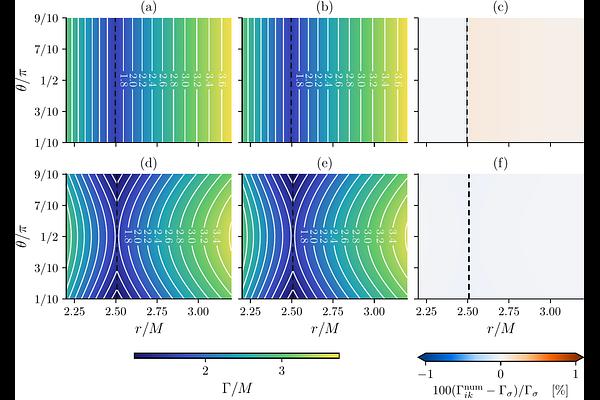
AbstractBlack-hole ringdown is usually modeled as a linear superposition of quasinormal modes, and fits to gravitational-wave observations increasingly include high overtones. However, the overtone sum does not necessarily converge: overtones are more strongly damped and thus decay faster in time, but their amplitudes in the Green function (the signal at an observer produced by an impulse at a source point) grow, so the mode description may break down before a finite time. We show that for a rotating (Kerr) black hole this time has a clear geometric meaning. For highly damped modes, the amplitudes grow exponentially with the optical distance from the source and the observer to a characteristic "bounce" radius close to the black hole, defined as the location where the mode amplitude is smallest. For one family of modes, the amplitudes are also suppressed the farther the source and observer sit from the equatorial plane. Rotation therefore makes the onset of convergence depend on direction as well as distance, extending the geometric picture from bounce radii to bounce surfaces. Combining these effects gives a sufficient condition for absolute convergence. For spin $a/M = 0.7$, we map how this time varies with source and observer position, and amplitudes computed numerically reproduce the predicted spatial dependence to better than one percent. These results set geometric limits on when the quasinormal-mode sums converge.