Accurate identification of invasive Aedes mosquito species using low-cost imaging and geometric wing morphometrics

Accurate identification of invasive Aedes mosquito species using low-cost imaging and geometric wing morphometrics
Sauer, F. G.; Joest, H.; Sulesco, T.; Duve, P.; Loc, D. H.; Nolte, K.; Luehken, R.
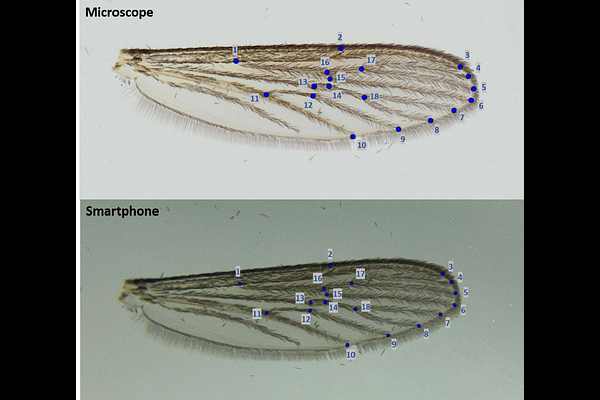
AbstractAccurate species identification is crucial to assess the medical and veterinary relevance of a mosquito specimen, but it requires high experience of the observers and well-equipped laboratories. This study aimed to evaluate whether low-cost imaging in combination with geometric wing morphometrics can provide accurate identification of invasive, morphologically similar Aedes species. The right wings of 670 female specimens covering 184 Ae. aegypti, 156 Ae. albopictus, 166 Ae. j. japonicus and 164 Ae. koreicus, were removed, mounted and photographed with a professional stereomicroscope (Olympus SZ61, Olympus, Tokyo, Japan) and a macro lens (Apexel-24XMH, Apexel, Shenzhen, China) attached to a smartphone. The coordinates of 18 landmarks on the vein crosses were digitalized by a single observer for each image. In addition, the landmarks of 20 specimens per species and imaging device were digitalized by six different observers to assess the degree of the observer error. The superimposed shape variables were used to compare the species classification accuracy of linear discriminant analysis (LDA), support vector machine (SVM), Random Forest (RF), and XGBoost. In the single-observer landmark data, the LDA achieved the best classification results with a mean accuracy of 95 % for landmarks from microscope images and 92 % for those obtained from smartphone images. In the multi-observer landmark data, LDA consistently performed worse than the other three classifiers, and the reduction in the accuracy was more pronounced for smartphone images than for microscope images. This pattern was associated with a higher degree of observer error for smartphone images, as confirmed by a landmark-wise comparison across all landmarks. Geometric wing morphometrics provides a reliable method to distinguish the most common invasive Aedes species in Europe. Thereby, the image quality obtained by smartphones equipped with a macro lens is sufficient and represents a cost-effective alternative to professional microscopes. However, due to the greater degree of observer variation for smartphone images, landmark coordinates for such images should ideally be collected by a single observer.