Orbit-averaged spinning and eccentric binary black holes: Hamiltonian and integrability

Orbit-averaged spinning and eccentric binary black holes: Hamiltonian and integrability
Tom Colin, Sashwat Tanay, Manuel Alva-Morales, Prateek Anand
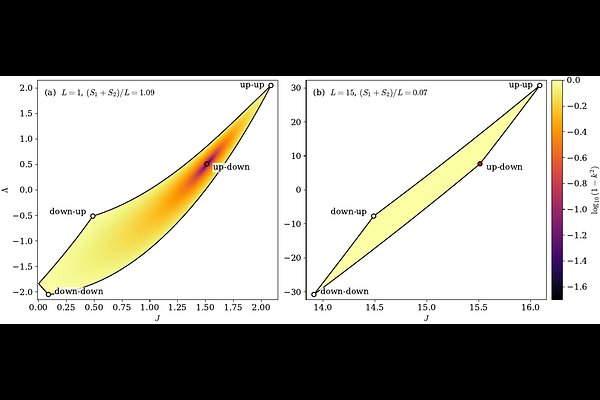
AbstractFor over two decades, the orbit-averaged precession equations of spinning binary black holes at second post-Newtonian order have been a standard model for their spin dynamics. One of their constants of motion, the projected effective spin, underlies the stability analysis of aligned-spin configurations and the construction of analytical solutions. The system is known to be Hamiltonian and integrable, its Hamiltonian being the orbit average of the full post-Newtonian Hamiltonian. Independently, we derive this Hamiltonian from the equations of motion alone, show why the orbit average gives the correct equations, and relate its constants of motion to those of the full system. We then construct the action-angle variables and frequencies with the recently introduced method of fictitious variables, and propose a criterion for the breakdown of the integrability conditions. This criterion recovers the separatrices of simple classical systems and the up-down instability, whose thresholds we give explicitly for eccentric orbits. We also show that, when all binaries of an ensemble share the same parameters and radiation reaction does not depend on the spins, the Hamiltonian structure preserves an isotropic distribution of spin directions. We confirm numerically that isotropy can be lost when the parameters are correlated with the spin directions. Finally, we use the orbit-averaged Hamiltonian to generalize the projected effective spin to binary neutron stars, for which it is not conserved, and obtain a closed form valid for eccentric orbits.