Reconstituting Mouse Embryogenesis Ex Utero from Gastrulation to Fetal Development Reveals Maternally Independent Metabolic Programs

Reconstituting Mouse Embryogenesis Ex Utero from Gastrulation to Fetal Development Reveals Maternally Independent Metabolic Programs
Lokshtanov, D.; Gao, S. M.; Xu, W.; Kosman, A.; Roncato, F.; De La Cruz, N.; Khan, N. A.; Woods, A.; Campbell, I.; Woehler, A.; Christoforou, C.; Ding, L.; Hu, A.; Copeland, M.; Wang, L.; Yang, X.; Raley, C.; Delventhal, K.; Herrera, A.; Valente, A.; Wright, S.; Gomez-Cesar, E.; Shlomo, R.; Golenchenko, S.; Oldak, B.; Yilmaz, A.; Gurhan-Sevinc, G.; Comar, M.-Y.; Viukov, S.; Novershtern, N.; Zhang, H.; Duong, T.; Li, L.; Khatib, N.; Kakun, R. R.; Espinosa-Medina, I.; Florian-Rodriguez, M. E.; LaManno, G.; Tillberg, P. W.; Wang, M. C.; Maza, I.; Srivatsan, S.; Solmonson, A.; Hanna, J. H.; Aguile
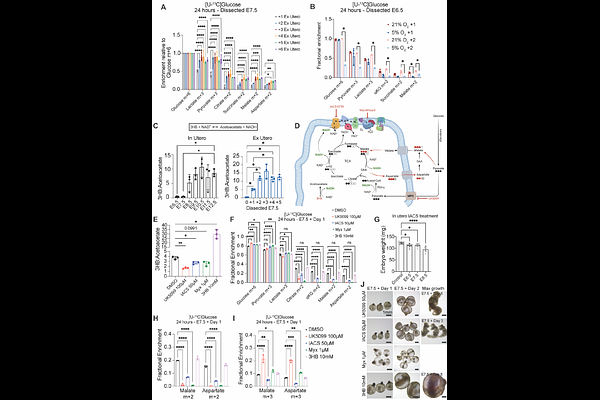
AbstractMammalian development takes place inside the maternal uterus, creating technological constraints that make difficult the study of embryogenesis in live developing embryos. A central challenge for understanding the role of metabolism in mammalian development is discriminating placental and uterine-regulated signals from embryo-intrinsic processes independent of maternal influence, a process that until now has remained inseparable during gastrulation and organogenesis. Ex utero culture systems allowing continuous growth of embryos during pre-gastrulation to organogenesis offer a promising solution to this challenge. Here, we present optimized ex utero culture platforms that support faithful development of mouse embryos from gastrulation (embryonic day 6.5/7.5) through the fetal period (embryonic day ~12.5) and harnessed these platforms for dissecting metabolic transitions in vivo during embryogenesis independently of uterus and placenta. We characterized the metabolome of in utero and ex utero whole embryos, fetal organs and culture medium between embryonic days E6.5 and E12.5 by liquid chromatography mass-spectrometry (LC-MS) metabolomics, isotope tracing, and single cell transcriptomics. These datasets present a comprehensive overview of the dynamic embryonic metabolism during gastrulation and organogenesis in utero and ex utero. This analysis revealed that the midgestational metabolic switch occurring at E10.5-E11.5 is faithfully recapitulated ex utero, indicating that this transition is intrinsically programmed in embryonic tissues and does not require direct maternal or placental cues. Notably, oxygen availability modulated the extent of this transition, but elevated oxygen was insufficient to induce it prematurely, demonstrating that the switch is developmentally timed and only partially environmental-responsive. We further harnessed the ex utero platform for identifying and perturbing a mitochondrial redox shift at E7.5-E8.5 that is critical for developmental progress after gastrulation. These findings uncover the remarkable metabolic plasticity of the mammalian embryo, demonstrating its capacity to sustain growth independently of maternal inputs from the establishment of the body plan through the onset of the fetal period. Moreover, they highlight the use of long-term ex utero culture as a unique framework for dissecting the mechanisms that shape embryogenesis under physiological and experimentally perturbed conditions, while functionally uncoupling embryonic programs from maternal and placental influences.