Memory reactivation during sleep promotes structure abstraction

Memory reactivation during sleep promotes structure abstraction
Solomon, S. H.; Krishnamurthy, S.; Siefert, E. M.; Gonciulea, C. M.; Schapiro, A. C.
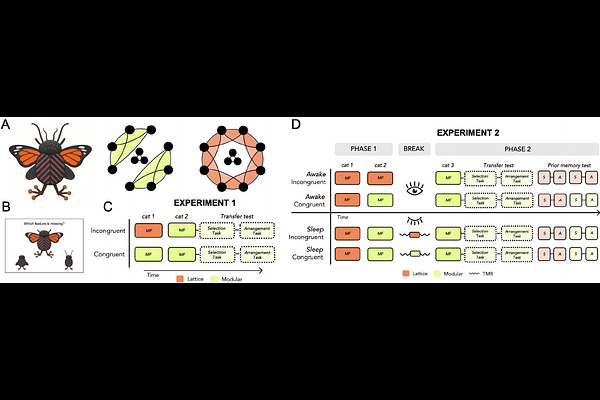
AbstractWe readily detect structure in our environments, which in turn guides future learning. Disentangling this structure from the superficial features of a specific learning environment provides an especially strong basis for future generalization, but it remains unclear when and how this kind of abstraction occurs. Memory reactivation during sleep has been hypothesized to support such abstraction, but this has yet to be directly tested. Here we examined this hypothesis by teaching participants novel categories in which patterns of feature covariation were governed by different graph structures. Participants then learned a new category, defined by entirely different features, whose structure was either congruent or incongruent with a previously learned category. If structural knowledge is abstracted away from superficial features, it should facilitate transfer when structures are congruent. In Experiment 1, when two categories were learned in immediate succession, participants showed no transfer benefit, suggesting that structure understanding remained tied to the original features. In Experiment 2, we tested whether offline processing promotes abstraction. Participants either remained awake between learning phases spaced 3 hours apart, or took a nap during which a previously learned category was reactivated using targeted memory reactivation (TMR). Transfer benefits emerged only when the reactivated and target categories shared the same structure, and these benefits increased with the number of cues presented during slow-wave sleep. These findings provide the first direct evidence that memory reactivation during sleep promotes the abstraction of structure, enabling knowledge to transfer across learning episodes with no overlap in features.