Statistics of Marginal Wavefunctions as a Real-Space Diagnostic of Quantum Entanglement

Statistics of Marginal Wavefunctions as a Real-Space Diagnostic of Quantum Entanglement
Ivan P. Christov
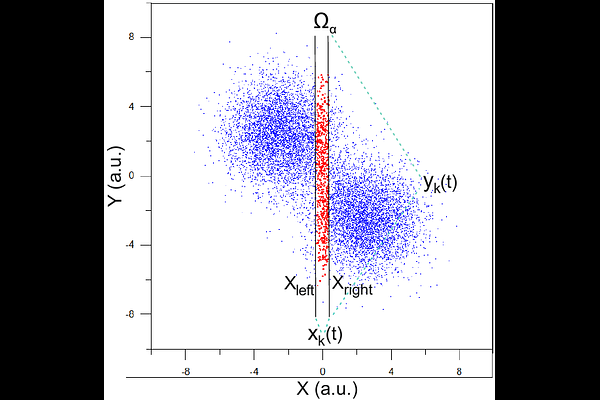
AbstractWe present a statistical framework for extracting spatially resolved entanglement directly from an ensemble of marginal (one-body) wavefunctions in Time-Dependent Quantum Monte Carlo (TDQMC). Treating the guide waves as a statistical mixture in Hilbert space, we show that the Gram matrix acts as a covariance operator whose spectrum coincides with the Schmidt spectrum. The associated functional standard deviation closely tracks the von Neumann entanglement entropy both globally and locally via walker partitioning, providing a physically transparent real-space diagnostic of quantum correlations without requiring construction of the full many-body wavefunction. Applications to one-dimensional two-electron bosonic and fermionic systems (helium atom and hydrogen-like molecule) demonstrate excellent agreement with strict conditional-wave results for opposite-spin electrons. For same-spin fermions, TDQMC statistical treatment of exchange symmetry yields positive, physically consistent local entropies. The method establishes a direct bridge between classical ensemble statistics and quantum entanglement measures, offering a computationally efficient real-space diagnostic tool for mapping the spatial distribution of correlations.