Ruffled minds? First insights into restlessness as a potential novel indicator of impaired welfare in bulls fattened for meat production

Ruffled minds? First insights into restlessness as a potential novel indicator of impaired welfare in bulls fattened for meat production
Hintze, S.; Wildemann, T.; Krottenthaler, F.; Winckler, C.
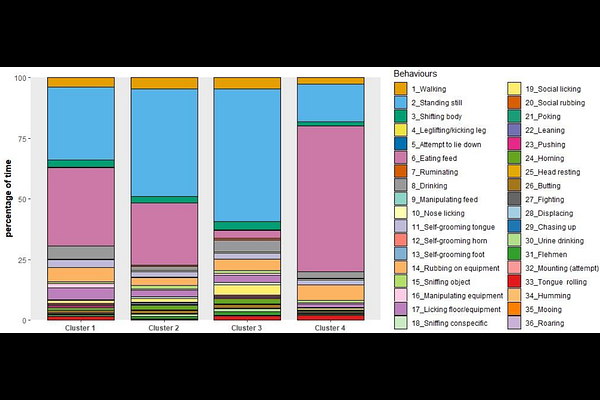
AbstractRestlessness is a symptom of chronic boredom in humans and a behavioural phenomenon anecdotally described as a concern in bulls raised for fattening purposes, but it has so far not been addressed in research. The two studies presented in this paper aimed to gain first insights into restlessness in bulls. We operationally defined restlessness by the number of transitions between behaviours in a given time period, and quantified restlessness in bulls of different weight classes (300, 400, 500 kg) on farms keeping bulls on fully-slatted floors (n=8, Study 1) as well as across three different husbandry systems (fully-slatted floor (FS, n=4), straw-based (SB, n=4) and organic pasture (OP, n=3), Study 2). All farms were visited twice, and the behaviour of different individuals was continuously recorded for 15 minutes each between 9 a.m. and 5 p.m. (Study 1) and for 8 minutes each between 6 a.m. and 10 p.m. (Study 2). The effects of weight class and husbandry system were analysed using generalised linear mixed-effects models, and we ran a sequence analysis to cluster observations by the sequence, frequency, and duration of bulls' behaviours in Study 1. Bulls kept in fully-slatted floor systems in Study 1 changed their behaviour on average 48.3 times per 10 minutes, with high variability both within and across farms. Weight class did not have a statistically supported effect on the number of transitions, and the sequence analysis revealed four clusters that differed in sequence and in the number of transitions. In Study 2, OP bulls showed fewer transitions than SB and FS bulls (X^2_2 = 23.6, p < 0.001), while SB and FS bulls did not differ. While SB pens were more structured and offered more space per animal, both SB and FS systems can be characterised by monotony, which may explain the similar level of restlessness in both systems. Alternatively, or in addition, the high feeding intensity in SB and FS systems may have caused the higher number of transitions compared to the OP system, potentially elicited by subacute ruminal acidosis and/or laminitis and the resulting pain. However, these explanations are speculative and require systematic disentanglement in future studies. This study provides initial insights into restlessness in bulls and lays the groundwork for future research to identify the causes underlying restlessness and investigate its association with bull welfare.