LLM-Guided Evolutionary Search for Algebraic T-Count Optimization

LLM-Guided Evolutionary Search for Algebraic T-Count Optimization
Daniil Fisher, Valentin Khrulkov, Mikhail Saygin, Ivan Oseledets, Stanislav Straupe
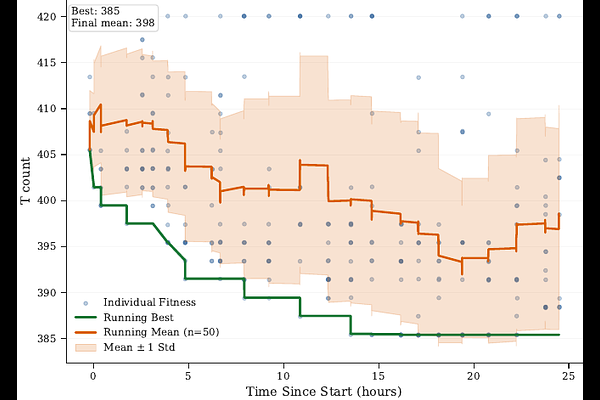
AbstractReducing the non-Clifford cost of fault-tolerant quantum circuits is a central challenge in quantum compilation, since T gates are typically far more expensive than Clifford operations in error-corrected architectures. For Clifford+T circuits, minimizing T-count remains a difficult combinatorial problem even for highly structured algebraic optimizers. We introduce VarTODD, a policy-parameterized variant of FastTODD in which the correctness-preserving algebraic transformations are left unchanged while candidate generation, pooling, and action selection are exposed as tunable heuristic components. This separates the quality of the algebraic rewrite system from the quality of the search policy. On standard arithmetic benchmarks, fixed hand-designed VarTODD policies already match or improve strong FastTODD baselines, including reductions from 147 to 139 for GF(2^9) and from 173 to 163 for GF(2^10) in the corresponding benchmark branches. As a proof of principle for automated tuning, we then optimize VarTODD policies with GigaEvo, an LLM-guided evolutionary framework, and obtain additional gains on harder instances, reaching 157 for GF(2^10) and 385 for GF(2^16). These results identify policy optimization as an independent and practical lever for improving algebraic T-count reduction, while LLM-guided evolution provides one viable way to exploit it.