Meaning-based guidance of attention in rhesus monkeys during naturalistic scene viewing

Meaning-based guidance of attention in rhesus monkeys during naturalistic scene viewing
Soyuhos, O.; Hayes, T. R.; Hu, W.; Hamel, T. P.; Sevak, B.; Henderson, J. M.; Chen, X.
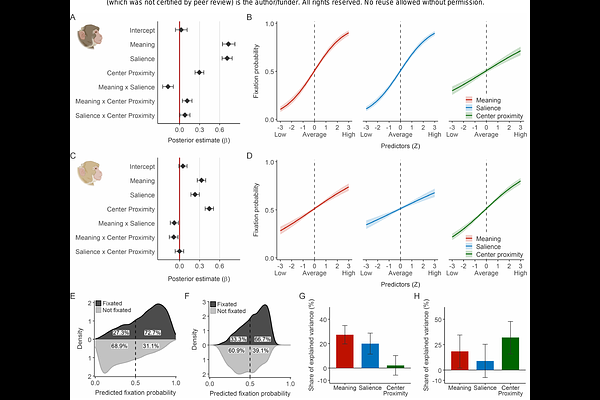
AbstractIn humans and other primates, high-acuity vision is restricted to the fovea, requiring frequent saccadic eye movements to sample visual information, a process known as overt attention. Classical visual salience theory explains how low-level image features guide these movements, but recent human studies have shown that overt attention is also strongly guided by scene meaning--the spatial distribution of semantic informativeness. Whether this form of attentional guidance is uniquely human or shared across primate vision remains unknown. Here, we addressed this question by recording eye movements from two rhesus macaques freely viewing naturalistic indoor scenes. Fixation selection was modeled using meaning maps alongside image-based salience maps and center proximity. In both monkeys, meaning robustly predicted fixation selection after controlling for visual salience and center bias. Moreover, high-meaning regions captured attention independently of visual salience, whereas salience played an increasingly important role as meaning decreased. While this prioritization of meaningful regions remained robust across environments, familiarity broadened visual exploration by increasing the likelihood of fixating less meaningful areas. Finally, the influence of meaning on fixation selection strengthened with attentional engagement. These findings suggest that meaning-based attention is an evolutionarily conserved component of primate vision and establish a behavioral foundation for investigating its neural mechanisms.