Localized Rigidification and Allosteric Modulation Mechanisms of SARS-CoV-2 Spike Neutralization by Class 3 and Class 4 Antibodies at Atomic Resolution: An Integrated Computational Study of Binding, Dynamics, and Allostery

Localized Rigidification and Allosteric Modulation Mechanisms of SARS-CoV-2 Spike Neutralization by Class 3 and Class 4 Antibodies at Atomic Resolution: An Integrated Computational Study of Binding, Dynamics, and Allostery
Alshahrani, M.; Gatlin, W.; Ludwick, M.; Turano, L.; Foley, B.; Verkhivker, G.
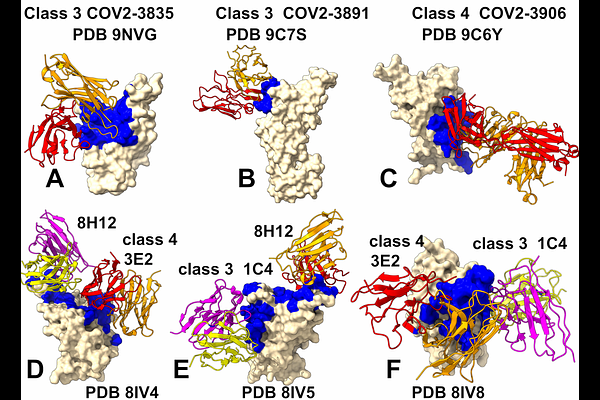
AbstractThe relentless evolution of SARS-CoV-2 and the emergence of highly antibody-evasive variants underscore the need to decipher the molecular principles that govern antibody neutralization breadth and resilience. In this study, we employ an integrated computational framework combining structural analysis, conformational dynamics, mutational scanning, binding energetics, and allosteric network modeling to dissect the mechanistic signatures of class 3 and class 4 antibodies targeting the receptor-binding domain (RBD) of the SARS-CoV-2 spike protein. Through comprehensive analysis of antibody-RBD complexes including individual antibodies (COV2-3835, COV2-3891, COV2-3906) and synergistic dual-antibody pairs we uncover a fundamental mechanistic dichotomy that distinguishes these two antibody classes and explains their differential patterns of neutralization potency, breadth, and resilience to viral escape. Our analysis reveals that class 3 antibodies achieve neutralization with mechanical perturbation strictly confined to the binding interface. In contrast, class 4 antibodies employ a long-range allosteric destabilization mechanism, anchoring to a structurally rigid hydrophobic core and establishing a mechanical conduit through the {beta}-sheet core that transmits conformational changes. Mutational scanning and rigorous energetic analysis reveal fundamentally different vulnerability landscapes: class 4 epitopes are defined by an immutable hydrophobic core that is exquisitely sensitive to mutation yet evolutionarily constrained across sarbecoviruses, explaining their ultra-broad binding and limited escape potential. Class 3 epitopes exhibit a plastic periphery with a conserved anchor and variable sensitivity in peripheral regions, creating multiple escape pathways. These predictions show excellent agreement with experimental deep mutational scanning data, validating our computational approach and establishing a quantitative framework for predicting immune escape. Allosteric network analysis identifies the {beta}-sheet core as the critical communication conduit for class 4 antibodies, with specific residues serving as essential hubs that connect the hydrophobic core to the RBM loop. The convergence of high communication centrality with extreme perturbation sensitivity at these positions establishes them as the most critical allosteric hotspots, essential for function and resistant to mutation. The proposed multi-pronged computational framework provides a generalizable approach for understanding antibody neutralization mechanisms and predicting immune escape across diverse viral targets, with implications for the rational design of next-generation antibody therapeutics that balance potency, breadth, and resilience.