Block Permutation Routing on Ramanujan Hypergraphs for Fault-Tolerant Quantum Computing

Block Permutation Routing on Ramanujan Hypergraphs for Fault-Tolerant Quantum Computing
Joshua M. Courtney
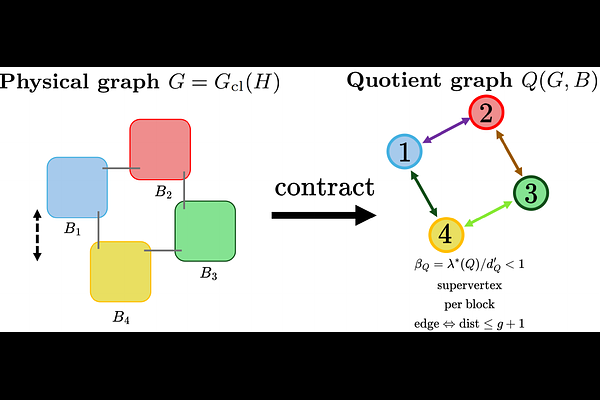
AbstractWe analyze permutation routing of rigid blocks representing surface code patches of $d_C^2$ atoms on a reconfigurable lattice with hypergraph transformations. For a hypergraph $H$, code distance $d_C$, $s=d_C^2$, number of blocks $N_L$, and guard distance $g$, we show the block routing number $\mathrm{rt}_B(H, s, g) = Θ(d_C \log N_L)$. A spectral analysis of the quotient graph $Q(G_{\mathrm{cl}}(H), B)$ (blocks as supervertices) shows that the spectral ratio $β_Q < 1$ is preserved in the high-connectivity regime. Negative association of block permutations and congestion bounds are used for random intermediate configurations. Serialization establishes that each quotient routing phase requires $O(d_C)$ physical sub-steps due to the block footprint width. A lower bound $\mathrm{rt}_B = Ω(d_C \log N_L)$ follows from combining the spectral lower bound on quotient phases with the traversal cost per phase. We include error model analysis grounded in recent experimental results, syndrome extraction protocols (stop-and-correct, rolling active fault-tolerant (AFT) measurement, and adaptive deformation), and integration with lattice surgery compilation via the Litinski protocol. Composition with the correlated-decoding scheme reduces syndrome-extraction overhead from $O(d_C)$ to $O(1)$ per correction window, leaving routing as the leading-order contributor to the integrated $O(d_C \log N_L)$ depth. Spectral inheritance is organized in a hierarchy: exact (Haemers interlacing on equitable partitions), perturbative (Weyl bounds for near-equitable partitions, a practically relevant case for surface-code patches), and universal (higher-order Cheeger). Methods extend directly to QCCD trapped-ion architectures under the same regime condition, with junction crossings replacing AOD transports as the elementary single-hop translation.