Gotta light? Illuminating AGN disks with LISA EMRIs

Gotta light? Illuminating AGN disks with LISA EMRIs
Federico Fantocolli, Francisco Duque, Jonathan Gair
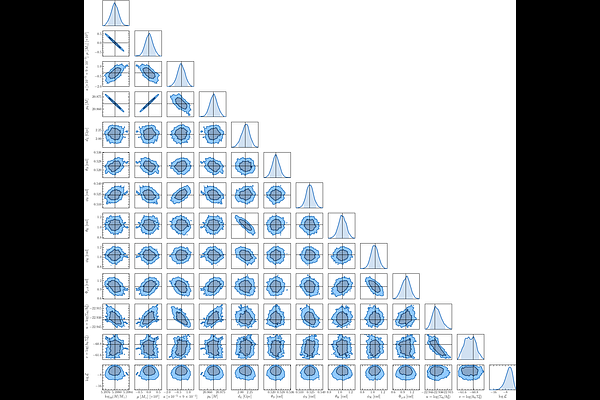
AbstractWe study the ability of the upcoming Laser Interferometer Space Antenna (LISA) to constrain gas torques acting on extreme-mass-ratio inspirals (EMRIs) when these are embedded in accretion disks, using recently developed relativistic models for the binary-disk interaction. Using a fully Bayesian setup, we find that, contrary to previous forecasts based on Newtonian results, these observations can provide simultaneous estimates of the disk surface density and the accretion rate (or, equivalently, its total luminosity) without the need for an electromagnetic counterpart. Our analysis also indicates that simpler measurement constraints based on the linear-signal (Fisher matrix) approximation are not valid for these systems. For typical EMRI observations, the torque amplitude can be constrained to within ~10%, strengthening the prospect of probing accretion physics at (sub)microparsec scales, deep in the strong-field gravity regime and complementing electromagnetic observations. This also strengthens LISA's ability to help answering questions such as how massive black holes grow and coevolve with their host galaxies and, by helping to identify the EMRI's host galaxy through cross-correlation with AGN catalogues, to improve the use of these sources as (dark) sirens for cosmology.