Molecular basis of protein-glycan cross-linking by CpCBM92A revealed by NMR spectroscopy

Molecular basis of protein-glycan cross-linking by CpCBM92A revealed by NMR spectroscopy
Trooyen, S. H.; Ruoff, M. S.; McKee, L. S.; Courtade, G.
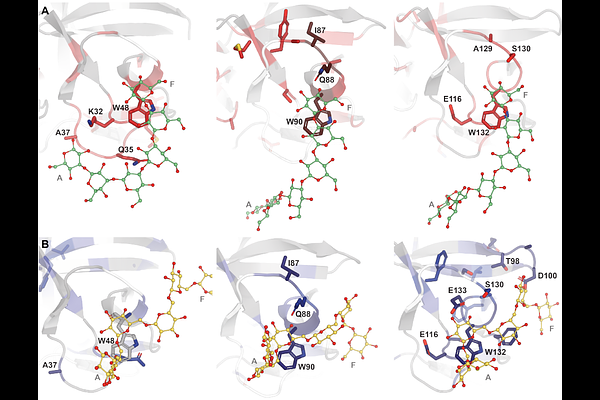
AbstractOur current understanding of carbohydrate-binding module (CBM) function is limited by the fact that most CBM research has focused on single-binding-site modules. CBM family 92 (CBM92) is a recently characterized family of predominantly trivalent proteins that bind {beta}-1,3- and {beta}-1,6-glucans with high specificity. CpCBM92A from Chitinophaga pinensis stands out as the first trivalent member of the family to be structurally determined. Multivalent CBM families are rare, and the way in which the three binding sites cooperate in ligand recognition remains unclear. Here, we use NMR spectroscopy to demonstrate how each of the protein's binding sites plays distinct roles in ligand binding. One binding site, referred to as the {beta} site, can be identified as the primary attachment point because of its higher affinity for all tested ligands, consistent with previous biochemical data suggesting it is the strongest binding site on CpCBM92A. The other two binding sites, referred to as and {gamma}, preferentially bind longer segments of {beta}-1,3- and {beta}-1,6-glucan chains, respectively. We further show that the glycosidic bond position and anomeric configuration of the binding glucosyl unit strongly affects protein affinity due to a preferred ligand pose in the binding sites. Our results provide insight into how the trivalent architecture of CBM92 might enable cross-linking of scleroglucan chains, which may guide the development of new applications for CBMs in biotechnology.