Deep learning based behavioral analysis in a neonatal rat model of hypoxic ischemic brain injury

Deep learning based behavioral analysis in a neonatal rat model of hypoxic ischemic brain injury
Lee, B.; Xing, H.; Wang, B.; Lam, M.; Chen, X. F.
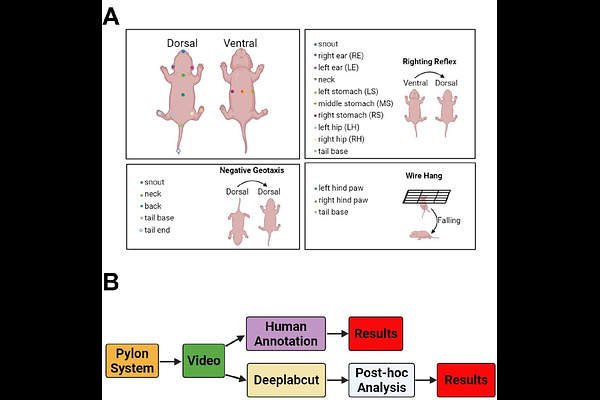
AbstractHypoxic-ischemic (HI) brain injury in neonates is one of the leading causes of lifelong neurological disability. Behavioral tests in preclinical rodent models are widely used to assess motor and cognitive outcomes after HI injury; however, these assays usually depend on subjective and labor-intensive manual scoring. Recent advances in markerless pose estimation offer new opportunities for automated and reproducible behavioral quantification in animal and infant recordings, but their use in neonatal HI preclinical studies remains limited. Wistar rat pups underwent HI injury using the Rice-Vannucci model at postnatal day 7 (P7). Three developmental behavioral tests included righting reflex (P8), negative geotaxis (P14), and wire hang (P16), were recorded and analyzed by both a human rater and an automated pipeline using DeepLabCut (DLC), an open source markerless pose estimation framework. Automated measurements were compared with manual scores using Intraclass Correlation Coefficients (ICC), Bland-Altman analysis, and Pearson correlation. DLC-derived measurements demonstrated strong agreement with manual scoring across all assays. ICC values were 0.929 (95% CI 0.648-0.971) for righting reflex, 0.965 (0.888-0.989) for negative geotaxis, and 0.958 (0.876-0.985) for wire hang. An automated behavioral analysis framework integrating DLC-based pose estimation with rule based quantification and supervised machine learning offers a reliable and objective alternative to manual scoring in neonatal HI models, enabling more efficient and reproducible behavioral assessment.