Macrophage calcium signaling dynamics revealed using genetically-encoded sensors

Macrophage calcium signaling dynamics revealed using genetically-encoded sensors
Chalmers, S. B.; Stewart, T. A.; Hughes, K.; Kurumlian, A.; Folacci, M.; Gieniec, K. A.; Stevenson, A. J.; Teakle, N.; Sehgal, A.; Paydari, E.; Thomsen, J. S.; Irvine, K. M.; Pandzic, E.; Poole, K.; Hume, D. A.; Davis, F. M.
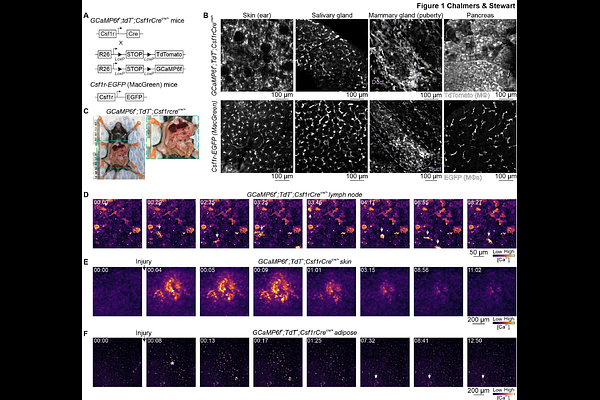
AbstractMacrophages (M{varphi}s) inhabit all mammalian organs, adapting to and influencing the tissues in which they reside. These versatile cells rapidly respond to tissue-specific signals, clean up debris and serve as the first line of defense against pathogens. Their ability to act quickly relates to their abundance and specific arrangement in tissues, as well as the systems they possess for detecting, processing and integrating emergent signals. Calcium (Ca2+) is a fast second messenger that has been linked to many of the core functions of M{varphi}s. However, spatiotemporal features of physiologically-relevant Ca2+ signals in M{varphi}s remain largely uncharacterized. Using mouse models expressing genetic biosensors and fluorescently tagged channels, we visualize M{varphi} Ca2+ signal dynamics and heterogeneity, uncover a remarkable degree of mechanosensitivity in these cells, and characterize the physiological consequences of genetic ablation of Piezo1 channels via analysis of knockout models across their lifetime. Our in-depth investigation of M{varphi} Ca2+ signaling dynamics has broad relevance for the field of M{varphi} biology and the tissues that these cells support.